Showing posts with label chai. Show all posts

Tuesday, August 08, 2023

Book alert!

Bantering with Bandits and Other True Tales (Aleph 2023) is just out. This is a new edition of Known Turf (2010), with a fresh Introduction chapter and a lot of footnotes that update the book's information with newer data, which lend it fresh context. 


This book of essays was nominated for the Crossword book prize in the non-fiction category when it first came out, and had a bunch of mostly good reviews when it first came out. It attempts to tell the story of our country in our times, with brief dips and detours into banditry, caste crimes, gender violence, displacement, hunger and malnourishment, faith and identity. All of these are, as I have learnt over the years, interlinked processes. I urge you to buy and read the book. 


Review links from 2010: 

"Annie Zaidi’s collection of essays, Known Turf, is arresting and unforgettable; about realities we prefer didn’t exist. Starvation deaths, female infanticide and communal intolerance step out of the anonymity of statistics to become people like us. They remind us of our defence mechanisms in the face of horror and sorrow; our efforts to stay sane and functional" - Karthika Nair in Tehelka

"Known Turf is a wonderfully engaging example of a puzzling trend in contemporary Indian writing in English. Despite the hype surrounding the novels-with-large-advances, the best writing today is happening in non-fiction." Alok Rai in Outlook

"Tragic and tender and brutal and funny." Known Turf covers a lot of turf.

"At its best, the book combines a reporter’s on-the-spot perception and a writer’s reflection and language to etch interesting, nuanced portraits of that half-mythical being in the throes of constant change: contemporary India. Known Turf is definitely worth reading, and not just for the sake of Gabbar Singh." Tabish Khair in Mint

"...anyone who has braved the railways without a confirmed reservation will get cathartic pleasure reading Zaidi’s graphic account of sitting on the corner of a seat, at a 45 degrees angle, with an RAC (Reservation against cancellation) ticket in a train to Lucknow" Alpana Chowdhury in DNA

"A book like this, written by someone who may once have been just as sheltered as they were, will resonate with Generation iPad in a way that a more world-weary account would bypass entirely." Manjula Padmanabhan in Outlook Traveller

"It’s a rare look into the lives of dacoits minus caricature.  Zaidi’s writing attempts to evoke an understanding of their reality.The Reporter and her Beat in Civil Society

"Among all the issues that Zaidi touches on, I find molestation to be the most moving. Though she puts in a lot of information on the other subjects she chooses, the whole force of her personality comes into play only when she starts speaking of molestation and eve teasing." From here

More reviews hereherehereherehere, and here.


Saturday, February 05, 2022

Happy Basant


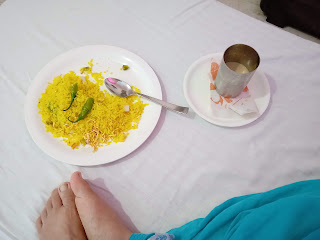
I was looking for a bright yellow photo to post on social media for Basant Panchami. Among my saved photos, I found this one. I am in a hotel room, on a research trip to Sirohi in 2019, for my book 'Bread, Cement, Cactus: A Memoir of Belonging and Dislocation'.

In most small hotels in central and western India and many parts of the north too, especially in district headquarter towns, small-ish hotels are the only option available to travellers. These tend to be usually business travellers rather than tourists or researchers. In such places, if you want tea or breakfast, you have to call the reception (if the room phone works) and ask for one of the employees to go to a local dhaba and fetch something to eat. The only option is poha (unless you want samosa or jalebi first thing in the morning, which I don't). You see my feet in the photo because I was sitting on the bed and eating. There was no table to eat at.

Here's to research, to travel, and to poha (although the featured poha in this photo was a sad little dish; I prefer it with lots of peanuts, potatoes, and even shredded chicken in mine).

Sunday, January 08, 2017

Wheels on my mind

Last year (summer of 2016), I had the good fortune of travelling abroad the Deccan Odyssey, a train that travels around Maharashtra to sites of artistic and historic significance such as Ajanta and Ellora, and also to two wildlife reserves, Tadoba and Pench. An essay about the experience was written for Conde Nast India. A brief extract here:

How many years did it take to just prepare the mud plaster surface? From how far away were the paints sourced? How does one go on painting, knowing the work may not be completed in one’s own lifetime? Walking through the monks’ bare cells—nothing here except a flat slab of rock to sleep on—felt like walking through a place of surrendered ego. Thinking of their calm acceptance of mortality, and the need to create beauty under all circumstances, filled me with a sort of hush. As much
 of a hush, anyway, as is possible at a popular site of tourism in India. At both places, I split from the group in search of silence and was struck, not so much by what the centuries left unchanged, but by the inevitability of change. Buddhist philosophy changed, drawing from both Tibetan and Hindu mythologies. Kings and nobles changed religious affiliation—Jain, Buddhist, Shaivite— and that decided what temples would be built. The hills themselves have been worn down to their present squat solidity. No destiny, not even one cast in stone, is set in stone.

Saturday, October 15, 2016

Lab-band, labaalab, lab-soz

Well, we are all doomed to turn into the thing we turn up our noses at. And besides, I did not necessarily enjoy all those non-discriminatory varieties of chai. One particular concoction, often encountered in Madhya Pradesh and Rajasthan, made me want to throw up. It took me a while to figure out that the problem lay in the water (high on fluoride). In other states, especially Punjab, there was the opposite problem. There was no water at all in ‘doodh-patti’ (milk and leaves). This is essentially full-cream milk lightly flavoured with tea, a mark of either prosperity (cows and buffaloes in the household) or warm hospitality (you wouldn’t serve watery tea to a visitor). And then there was the delightfully named abomination, ‘khade chammach ki chai’ — tea with so much sugar, the stirring spoon stands upright in the glass.
It is the last type for which I found a heart-stoppingly romantic description in a new documentary film on tea, Steeped and Stirred. A nonagenarian from Hyderabad said it was called ‘lab-bandh’, Urdu for sealed lips. In other words, tea so sweet it practically sealed your lips. The other two attributes of a truly desirous cup of tea, he recalled, were ‘labaalab’ (full to the brim) and ‘lab-soz’ (hot enough to scald the lips).
From a short article I wrote about my own relationship to tea and about a new documentary film made by someone whose passion seems to rival mine. Read the full piece here: 

Thursday, January 08, 2015

Thela aur thithak: kuch yaadein

I have been searching online for the English translation of "thithak" – "baulk" comes closest but it does not quite capture the mix of emotions – hesitation, surprise, confusion, discomfort – represented by the Hindi word "thithakna".
Thithakna is what happens to regulars at a roadside chai stall whenever I stop by for a cup of tea like the men do – alone, sipping slowly, looking at the passing traffic, street signs, posters pasted on walls.
Tweets by @anniezaidi