Showing posts with label freedom. Show all posts

Thursday, January 25, 2024

Review: Stories about being Muslim in contemporary India

My review of Tabish Khair's latest collection, Namaste Trump and Other Stories

The book’s structure is imaginative, if also unusual. While its contents can be described as split into two broad sections–the novella Night of Happiness, which was published as a standalone in India in 2018, and a set of short stories–it would not be wise to read the novella as distinct from the stories. In fact, it is impossible to read each story as a self-contained whole to the extent that the same characters re-appear in more than one story; the narrative appears to pick up where it had been left off, with a different story inserted in between. 

Why has the author chosen this unusual approach instead of simply writing two or three novellas, and what should we read into the placement of the pieces? To me, it appears that Khair is nudging the reader to look beyond the events of individual stories, to seek out patterns, and to pay attention to the movements of time and shifts of location that the characters undergo. Some characters are semi-rural while others are firmly urban but all are strung together on the twin threads of Phansa, a small town in Bihar, and the experience of being Muslim in contemporary India, be it as protagonist, victim or observer... The horror of violence – past, present or future – repeatedly manifests in these stories in the shape of a paranormal experience. The sympathetic narrator of Night of Happiness must contend with an invisible halwa that leads him to feel “a bony hand” clutching at his heart. 

The titular story, “Namaste Trump” reveals the banal cruelty of a cynical upper-class executive who turns out a domestic worker during the COVID-19 pandemic, an act that has spiritual consequences. “Shadow of a Story” is a proper ghost story where Khair is in his element as a writer of fiction working in academia. Its narrator is a man who takes literature seriously and is able to reconsider positions taken in the context of literary criticism, and reassess his own valourisation of a particular postcolonial aesthetic after an encounter with brute violence in Phansa. Truth appears as a frightening presence in “The Thing with Feathers.” A personal favourite, this is a story about the unravelling of a teacher, Rakesh Sir, who “did things properly, always within limits” but who loses control of his tongue, and thus inadvertently becomes dangerous. The author once again drives us to a junction of reason where the evidence provided by one’s physical senses and simple common sense collides with an intangible, unbelievable world where the rules of our world no longer hold good. 

Through these Phansa-connected stories and their chaotic or uncanny outcomes, Khair reveals to us a landscape where petty cruelty is interlaced with looming threats of violence or destitution, and also with a quiet courage that approaches madness. It is a landscape filled with memorable characters that the reader can carry into, or far beyond, the towns and villages of their own origin. 

Friday, November 03, 2023

A brief meditation on selfies and resilience

Once upon a time, I was judgmental about selfies. From film stars to your third cousin, everyone was pouting, clicking, and uploading selfies on social media, and I was disapproving. A photograph taken by others captures more of the physical environment, a more uncertain expression, a likeness that you cannot fully control. Selfies, on the other hand, give their subjects too much control. The selfie-taker is intent on being seen as they see themselves rather than on capturing memories. And how much memory could a selfie possibly contain?

I bit down on my disapproval though, and read scholarly commentary on the sociocultural implications of relentless self-portraiture: what does it say about our generation? What does it say about societies where women are unsafe when they become visible, or where self-fashioning comes with a side of grievous harm? Perhaps selfies were good for something after all, if they could help us understand ourselves?

I cringe now to think of that former self—so blinkered, she didn’t even know how to look at herself squarely in the eye. How, then, did I get to a point where I have a folder full of goofy selfies and where my own self-portraiture is unapologetic?

The answer lies buried in an analogue photo album.

Tuesday, August 08, 2023

Book alert!

Bantering with Bandits and Other True Tales (Aleph 2023) is just out. This is a new edition of Known Turf (2010), with a fresh Introduction chapter and a lot of footnotes that update the book's information with newer data, which lend it fresh context. 


This book of essays was nominated for the Crossword book prize in the non-fiction category when it first came out, and had a bunch of mostly good reviews when it first came out. It attempts to tell the story of our country in our times, with brief dips and detours into banditry, caste crimes, gender violence, displacement, hunger and malnourishment, faith and identity. All of these are, as I have learnt over the years, interlinked processes. I urge you to buy and read the book. 


Review links from 2010: 

"Annie Zaidi’s collection of essays, Known Turf, is arresting and unforgettable; about realities we prefer didn’t exist. Starvation deaths, female infanticide and communal intolerance step out of the anonymity of statistics to become people like us. They remind us of our defence mechanisms in the face of horror and sorrow; our efforts to stay sane and functional" - Karthika Nair in Tehelka

"Known Turf is a wonderfully engaging example of a puzzling trend in contemporary Indian writing in English. Despite the hype surrounding the novels-with-large-advances, the best writing today is happening in non-fiction." Alok Rai in Outlook

"Tragic and tender and brutal and funny." Known Turf covers a lot of turf.

"At its best, the book combines a reporter’s on-the-spot perception and a writer’s reflection and language to etch interesting, nuanced portraits of that half-mythical being in the throes of constant change: contemporary India. Known Turf is definitely worth reading, and not just for the sake of Gabbar Singh." Tabish Khair in Mint

"...anyone who has braved the railways without a confirmed reservation will get cathartic pleasure reading Zaidi’s graphic account of sitting on the corner of a seat, at a 45 degrees angle, with an RAC (Reservation against cancellation) ticket in a train to Lucknow" Alpana Chowdhury in DNA

"A book like this, written by someone who may once have been just as sheltered as they were, will resonate with Generation iPad in a way that a more world-weary account would bypass entirely." Manjula Padmanabhan in Outlook Traveller

"It’s a rare look into the lives of dacoits minus caricature.  Zaidi’s writing attempts to evoke an understanding of their reality.The Reporter and her Beat in Civil Society

"Among all the issues that Zaidi touches on, I find molestation to be the most moving. Though she puts in a lot of information on the other subjects she chooses, the whole force of her personality comes into play only when she starts speaking of molestation and eve teasing." From here

More reviews hereherehereherehere, and here.


Sunday, May 21, 2023

Sad Stories You are Old Enough to Hear

Eight years ago, I had my first essay accepted in the Griffith Review. 'Embodying Venus' was a meditation on women's bodies and (un)covering and the politics around it. There were a few more pieces in the journal since: 'Golden Girls' about the rise of young female wrestlers in India, 'Dangerous Little Things' about the significance of student politics, and a short story about ideological wars on Twitter, 'Cows Come Home'.

This year, again, I have a piece in their newest edition, Creation Stories. It is written in the form of a letter to a beloved young person who is growing up in fraught times: Sad Stories You are Old Enough to Hear


Dear A, 

The other day, I told you to stay out of it when two adults were talking about something serious. I saw your face, startled perhaps that this should come from me. I regretted it at once, partly because you are not a child. You are what we call ‘young adult’ in the world of literary endeavour and a young adult must be allowed into adult conversations. I know that my concerns may not be yours and perhaps even your sense of identity is not the same as mine. Perhaps you will be content to define yourself through pronouns or talent and no other struggle will be necessary. Still, we share blood, history and a love of stories, and I want to tell you some true stories today. Destabilising stories that offer neither resolution nor catharsis. Stories that go on, like an underground railroad loop inside your head. Stories that may explain the prickly, fragmented being you sometimes catch a glimpse of, before I clumsily gather myself. You will not remember it, but there’s a fragment of me permanently embedded on a railway platform in Mumbai...


The whole piece is behind a paywall but do read it here: https://www.griffithreview.com/articles/sad-stories-you-are-old-enough-to-hear/?fbclid=IwAR2xV0B2_KcjkLdCvNQH2TT9yRNNS697-_Slrq2GwCd43R5RKtlTFlC64hI 

Wednesday, March 09, 2022

On coverings of face or head, and the cultural value of uniformity

A good school or college teaches students to see people for the good or harm they do rather than focus on their skin, surnames, hair or tiffin-boxes. No society can hope to emerge from the dark pit of ignorance if it refuses to allow experiments with appearance, habits, even cultural values. What is ignorance, after all, but not knowing? Knowledge comes from seeing, listening, recognising, interpreting. A mulish refusal to allow difference is rooted in an irrational fear of knowledge. If uniform rules lead to the denial of education, the best academic response is to discuss the role of uniformity as a cultural value.

That schools and colleges should refuse to accept a covered head is distressing. Even more distressing is their argument broken down: you are only acceptable if you show exactly as much skin or hair as we demand. This is as good as saying: you have no right to govern your own body. This is a dangerous idea to put into any institution, private or public, and especially dangerous for women if endorsed by the state and courts of law.

Those who use the ‘uniform’ argument to keep Muslims out of educational institutions have struck a double blow. The first blow lands on the rights of Muslim students while the second lands upon the hearts of Hindu students whose capacity for critical thought and solidarity is being squeeze-shrunk out of them. They are being taught that it is okay to reject someone based on their appearance, that it is okay to bully or hate those who are different. Worse, it pushes forward the idea that cultural identities are fixed and citizens have no right to multiple or overlapping identities.

There have been some mal-intentioned arguments on social media, based on pictures of girls with and without the hijab, seeming to make the argument that if a girl can show her hair in one location, among one set of people, she has no right to cover herself in another location. The dangers of this argument are so great, and so obvious, that I am amazed at how little pushback there has been from women’s groups across the country.

Some thoughts triggered by hostile reactions to masks and to hijabs in recent weeks. Read the full article here: 


Wednesday, January 26, 2022

The heart of the republic

Freedom is not simply a matter of being fed. The technical lack of a cage also does not define freedom. She may be trained to perform on stage through a judicious mix of fear, pain and food, but a lioness balancing on a chair and being ridden by a clown cannot be called free.

Hunting and killing also do not necessarily translate to freedom. A lioness must also be free to not hunt and not kill when she chooses. One who is expected to tear into a gladiator, or an unarmed Christian convert, is no freer than the human she will kill.

Freedom, then, is a form of self-determination. Being able to make one’s own choices is vital to the process of achieving it, and inhabiting it. And what is the republic if not a human attempt towards self-determination?

Some thoughts on the republic, freedom and Born Free today in the Indian Express: 


Sunday, August 15, 2021

Some more thoughts on freedom

Squeeze your lids over your irises, until the inner mirror fogs over, and say the word ‘freedom’. What image do you see?

I see a keen blue and bale upon bale of cottony white sky. Freedom to me is an unbroken expanse, full of light, full of beauty and unlimited potential. Like the sky, it is unfailingly present. Like the sky, it is simultaneously universal and particular, and forever in need of watching. It changes each hour of each day, and my slice of sky can grow black and thunderous even as it remains blue for another citizen in another town. Yet, the sky is comprised of the same materials everywhere.

What of freedom: what is it made of? 

In an article about the dangers of a philanthropy-centric approach to pressing problems rather than a rights-based one, political philosopher Gwilym David Blunt had posed an interesting question: ‘Let’s say a kindly benefactor offered you a better standard of living than that which you currently enjoy, or can realistically aspire to, and credibly promises to treat you very well. The only condition is that they would own you. Would you accept the offer?’

I know I would not. And yet, why? What is it about this word — freedom — that I am willing to pay for it with my life? Why did our ancestors pay the ultimate price? Thousands were executed in 1857 and in the 90 years that followed, tens of thousands lost precious years of youth and health as they were jailed, exiled, stripped of their properties. The word gulaam, slave, was used to describe the status of India before we won Independence in 1947. It is a question still worth asking: what made us feel enslaved?

Some thoughts on what comprises freedom in this new essay in The Hindu


Monday, February 01, 2021

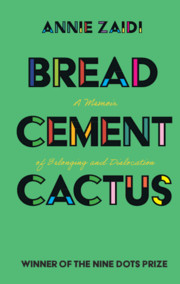
'Bread, Cement, Cactus': some reviews

Bread, Cement, Cactus: A memoir of belonging and dislocation is available in the USA, UK and in India, in print as well as in ebook format. You can buy the book at a bookstore or look it up online. 

A free download is also available at the Cambridge University Press (UK) website.


"In the author’s world, there is space to learn from family and strangers, boatmen and historians, poets and gangsters. She paints a vivid picture of the people she encounters in person or hears about from others. If they come from a different set of life circumstances, she uses that moment as an opportunity to reflect on her own position in society based on gender, language, marital status, religion, parentage and property. This inward gaze is missing from a lot of political analysis about the current state of the country, and that is why this book stands out for its sincerity. It is not a rant; it is sensitive and sophisticated."


- The Hindustan Times 


"In the end, the architecture of the book attempts to lead us towards a counter-resolution that will establish home instead in the paradise of personal experience – in “the morning mist” for example – but this is never as convincing as the lasting sense of indignation and injustice that Zaidi evokes. “What belongs to whom?” she asks. “Who pays the costs of what is taken and cannot be returned?” These are questions perhaps more powerful than the answers Zaidi can provide, but it’s through questions such as these that she points towards the deeper mysteries of our human condition."

- The Guardian 


"Zaidi is keen to tell the stories of people who lose power, and then have to give up ground. The migrants who live on the margins; the Adivasis, who “displaced often, end up in cities where they are reduced to penury and homelessness”; and minorities, including Muslims who face bias in everyday life.

So, this safe place called home, does it exist? For her, a home is where she wants to return to, the heart being a compass. Sometimes, she thinks of home as morning mist, wispy and beyond her grasp."

- The Hindu


"Zaidi shines a light on the horror of what an androcentric society is, yet reiterates the concept of dislocation not only to emphasize the pain women go through but the healing and belonging they could find when following their own path."


"The disenfranchisement of women, anti-migrant and anti-Muslim rhetoric, ghastly incidents such as how the body of a Dalit person was airdropped from a bridge to avoid the upper caste section of a crematorium, and the British legacies that still enable the displacement of forest dwellers and exploitation of natural resources, are juxtaposed alongside personal meditations. At one point, the author recalls how an experiment of living on the urban poverty line of Rs47 a day, even as a person without dependents, made her quickly realise: ‘…all the things that lend me a feeling of home—language, history, memory—would dissolve into the overwhelming consideration of hunger. Food would be home.’

In prose that is admirably both poetic and compact, Zaidi creates in Bread, Cement, Cactus both a memoir of her own multiple belongings as well as a tract that sets out India’s various modalities of displacement. ‘Dislocation can be abrupt but the internal compass dissolves slowly,’ she writes. This book ponders not only that slow dissolution, but a subsequent reassembling too—but always, with the sober acknowledgment of fragmentations yet to come."


Monday, May 04, 2015

A new anthology is out

For over three years now, I have been looking for and reading Indian women writers across genres as part of my research for a new anthology, which is now out as 'Unbound'. Here's the cover and (below) some links to interviewswhere I try and explain the processes, choices and motivations that drove me as I put together this manuscript.


From a piece about the book in the Bangalore Mirror:

"It was also important to challenge the way 'Indian' women are represented in popular culture. Motherhood is a minefield. Food is life itself. It is very boring to think of women and food only in one framework: woman preparing food at home. It is also an inaccurate portrait. I wanted to present a more authentic collage through the extracts I chose"

From an interview with Verve magazine:

8. Which are some contemporary female writers you admire?
“Oh, many, many, many! You will note that about half of the writers included in the book are indeed contemporary writers. I have, however, left out very ‘new’ writers – those who’ve started getting published only in the last 8 to ten years. This was a conscious decision because, sometimes, you are blown away by a new book but within a year, the new voice is already fading from your consciousness. Substance has to be balanced against style. A work may or may not have lasting value, but it is difficult to judge that in the short term. In my (limited) experience, it takes a distance of at least 10 years for me to be able to judge a piece of writing in isolation, to look at it against its own light, not against the light of all the other writing that surrounds it.”

Tweets by @anniezaidi