Showing posts with label prize. Show all posts

Tuesday, August 08, 2023

Book alert!

Bantering with Bandits and Other True Tales (Aleph 2023) is just out. This is a new edition of Known Turf (2010), with a fresh Introduction chapter and a lot of footnotes that update the book's information with newer data, which lend it fresh context. 


This book of essays was nominated for the Crossword book prize in the non-fiction category when it first came out, and had a bunch of mostly good reviews when it first came out. It attempts to tell the story of our country in our times, with brief dips and detours into banditry, caste crimes, gender violence, displacement, hunger and malnourishment, faith and identity. All of these are, as I have learnt over the years, interlinked processes. I urge you to buy and read the book. 


Review links from 2010: 

"Annie Zaidi’s collection of essays, Known Turf, is arresting and unforgettable; about realities we prefer didn’t exist. Starvation deaths, female infanticide and communal intolerance step out of the anonymity of statistics to become people like us. They remind us of our defence mechanisms in the face of horror and sorrow; our efforts to stay sane and functional" - Karthika Nair in Tehelka

"Known Turf is a wonderfully engaging example of a puzzling trend in contemporary Indian writing in English. Despite the hype surrounding the novels-with-large-advances, the best writing today is happening in non-fiction." Alok Rai in Outlook

"Tragic and tender and brutal and funny." Known Turf covers a lot of turf.

"At its best, the book combines a reporter’s on-the-spot perception and a writer’s reflection and language to etch interesting, nuanced portraits of that half-mythical being in the throes of constant change: contemporary India. Known Turf is definitely worth reading, and not just for the sake of Gabbar Singh." Tabish Khair in Mint

"...anyone who has braved the railways without a confirmed reservation will get cathartic pleasure reading Zaidi’s graphic account of sitting on the corner of a seat, at a 45 degrees angle, with an RAC (Reservation against cancellation) ticket in a train to Lucknow" Alpana Chowdhury in DNA

"A book like this, written by someone who may once have been just as sheltered as they were, will resonate with Generation iPad in a way that a more world-weary account would bypass entirely." Manjula Padmanabhan in Outlook Traveller

"It’s a rare look into the lives of dacoits minus caricature.  Zaidi’s writing attempts to evoke an understanding of their reality.The Reporter and her Beat in Civil Society

"Among all the issues that Zaidi touches on, I find molestation to be the most moving. Though she puts in a lot of information on the other subjects she chooses, the whole force of her personality comes into play only when she starts speaking of molestation and eve teasing." From here

More reviews hereherehereherehere, and here.


Sunday, June 19, 2022

A staging, at last

It has taken thirteen years but, finally, my play 'Name, Place, Animal, Thing' got staged. The Bay Area Drama Company produced it and Rita Bhatia directed the shows ran at Sunnyvale Theatre recently.


This script was shortlisted for The Hindu Playwrights prize in 2009, but was not staged at the time, partly because I was a freelance journalist who had very little contact with theatre makers. A couple of wonderful readings happened during the pandemic (Atri Bannerjee directed a dramatized reading for the Almeida Theatre in the UK and the Panas Panas Theatre in Kuala Lumpur did a Zoom reading) but this is the first time the play has been staged with costumes, props et al. 


I am glad that the artistic director, Basab Pradhan reached out and made this happen. I couldn't be there to watch the show but many others, especially the South Asian community in the Bay Area, did come to watch. This matters a great deal to me since the play focuses on the intersection of domestic work, class and gender as it plays out in South Asia. 

I was asked to write a blog post too, to help audiences engage deeper with the themes of the play. I wrote at some length so that readers may have a bit of historic perspective viz domestic work and child labour in independent India. Here's something to chew on: 

The Child Labour (Prohibition and Regulation) Act, 1986, was applicable to 64 professions that were deemed hazardous; domestic work was not included. Activists lobbied the Indian government to change the law so that children under the age of 14 could no longer be employed as domestic workers. Initially, the notification was restricted to government servants, who comprise a negligible percentage of the population. Still, the government did concede that children should not be employed in households. The work can be never-ending (a domestic worker can be woken up in the middle of the night to perform a chore) and the risks of exploitation are high since constant oversight is not possible.

In 2006, the government of India finally expanded this order into a law so that children under 14 are no longer permitted to undertake domestic work. However, there are an estimated 150 million child labourers between the ages of 5 and 14, of which at least 7.4 million are domestic workers. More recent studies suggest that 74 percent of child domestic workers in India are between the ages of 12 and 16. Clearly, implementation of the law is weak. Besides, the law only applies to children under 14. What happens to the 15-year-old who lives and works in someone else’s house?

One of the activists I'd met in 2006 told me that if the law were properly implemented, employers are afraid they will be “orphaned for the lack of a slave”.


The script is included in a set of three published in book form as well and you may buy it  online or, ideally, in any bookstore that stocks it. A Kindle version is also available here: 


Monday, February 01, 2021

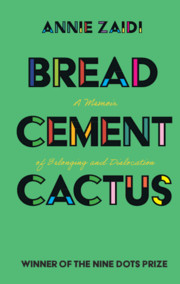
'Bread, Cement, Cactus': some reviews

Bread, Cement, Cactus: A memoir of belonging and dislocation is available in the USA, UK and in India, in print as well as in ebook format. You can buy the book at a bookstore or look it up online. 

A free download is also available at the Cambridge University Press (UK) website.


"In the author’s world, there is space to learn from family and strangers, boatmen and historians, poets and gangsters. She paints a vivid picture of the people she encounters in person or hears about from others. If they come from a different set of life circumstances, she uses that moment as an opportunity to reflect on her own position in society based on gender, language, marital status, religion, parentage and property. This inward gaze is missing from a lot of political analysis about the current state of the country, and that is why this book stands out for its sincerity. It is not a rant; it is sensitive and sophisticated."


- The Hindustan Times 


"In the end, the architecture of the book attempts to lead us towards a counter-resolution that will establish home instead in the paradise of personal experience – in “the morning mist” for example – but this is never as convincing as the lasting sense of indignation and injustice that Zaidi evokes. “What belongs to whom?” she asks. “Who pays the costs of what is taken and cannot be returned?” These are questions perhaps more powerful than the answers Zaidi can provide, but it’s through questions such as these that she points towards the deeper mysteries of our human condition."

- The Guardian 


"Zaidi is keen to tell the stories of people who lose power, and then have to give up ground. The migrants who live on the margins; the Adivasis, who “displaced often, end up in cities where they are reduced to penury and homelessness”; and minorities, including Muslims who face bias in everyday life.

So, this safe place called home, does it exist? For her, a home is where she wants to return to, the heart being a compass. Sometimes, she thinks of home as morning mist, wispy and beyond her grasp."

- The Hindu


"Zaidi shines a light on the horror of what an androcentric society is, yet reiterates the concept of dislocation not only to emphasize the pain women go through but the healing and belonging they could find when following their own path."


"The disenfranchisement of women, anti-migrant and anti-Muslim rhetoric, ghastly incidents such as how the body of a Dalit person was airdropped from a bridge to avoid the upper caste section of a crematorium, and the British legacies that still enable the displacement of forest dwellers and exploitation of natural resources, are juxtaposed alongside personal meditations. At one point, the author recalls how an experiment of living on the urban poverty line of Rs47 a day, even as a person without dependents, made her quickly realise: ‘…all the things that lend me a feeling of home—language, history, memory—would dissolve into the overwhelming consideration of hunger. Food would be home.’

In prose that is admirably both poetic and compact, Zaidi creates in Bread, Cement, Cactus both a memoir of her own multiple belongings as well as a tract that sets out India’s various modalities of displacement. ‘Dislocation can be abrupt but the internal compass dissolves slowly,’ she writes. This book ponders not only that slow dissolution, but a subsequent reassembling too—but always, with the sober acknowledgment of fragmentations yet to come."


Tuesday, December 29, 2020

Some thoughts on sanity, truth, violence and protest

I was interviewed recently by Saumya Kalia for Outlook magazine. One of the questions she put to me was taking off on something I said after my book Prelude to a Riot won the Tata Litlive Award for fiction. 

I directed my comments towards the sponsors of literature festivals and book prizes, and the question and answer that follow build upon some of my thoughts: 


"On winning the Tata Live book prize, you wrote about sponsored literary festivals and the motivation of the rich and powerful to get speakers to participate. For any society to remain sane, a little truth must survive, was your hypothesis. Can you explain what you mean by that?"

Me:  The question of who sponsors art, and what art achieves in any society, has been troubling me for a long time. The vision of artists and their sponsors is often at variance. How does this relationship work, then? Artists are dependent on others, not just for their income, but also for spaces (physical, digital, metaphorical) wherein they engage with their audience. Picasso can make Guernica, but where will it hang? Will it survive if the powerful decide to get rid of it? Some of the greatest Renaissance art in Italy was commissioned by patrons like the Medici family, bankers and businessmen. Why did they bother? We have had stories told down the ages about kings and queens, their infidelities, filicides and parricides. Books, plays, oral storytelling arts were supported by the nobility or very wealthy merchants for most of our history. Why did they not insist on censoring all stories so that the nobility was only cast in benevolent light?

This might be for multiple reasons. One, truth itself is powerful. Those who wish to remain powerful must retain an acquaintance with the truth. They may serve disinformation to the rest of the country, but they themselves must have access to correct information. They may not invest in mass access to the arts, but they themselves must have access to the vision, the beauty and even terrifying clarity that artists bring. Two, lack of truth is associated with breakdowns of all kinds. What do we recognize as a loss of sanity? It is a state in which you can no longer tell what is real and what isn’t, what is harmless and what isn’t. Individuals who lose touch with the truth react in unpredictable ways. A society cut off from the truth, and from truthful art, starts to lose itself in similar ways. It becomes unpredictable and does not necessarily act in self-interest, much less underwrites someone else’s profit. Alternately, the truth goes underground, leaving the powerful in the dark and, this is worse for them. Look at any society where truth and art have been suppressed, and you will see that it is a sick/sickening society or a nation at war. I don’t think this state of affairs suits too many people, not for too long anyway.

The full interview is available here: 

https://www.outlookindia.com/website/story/annie-zaidi-on-culture-of-protest-identity-and-expression/368316


Thursday, May 28, 2020

Monday, December 17, 2018

Three Plays/New book

Three of the plays I've written over the last decade have now been published in one volume. They include the first full length script I ever wrote, Name, Place, Animal, Thing, which was shortlisted for The Hindu Playwrights Prize in 2009, and Untitled 1, which won the same prize in 2018. The third script is a radio drama, Jam, which was named regional winner of the BBC International Playwriting Competition, 2011.

Please go forth and purchase: 3 Plays by Annie Zaidi


Thursday, August 16, 2018

With gratitude, some good news

A script I wrote recently, Untitled 1, has won The Hindu Playwright Award for 2018. I am glad and grateful and feel very lucky. 

Here is the announcement of the prize: 


And here is an interview with some detail about themes and characters in the play:

Tweets by @anniezaidi