One of the good things that happened over the last year: my short story, ‘Zinnias in the Graveyard’, won third prize (shared with Brecht De Poortere) at the Hudson Review Short Story competition 2024-25. It took a while but the story has finally been published in the Summer 2025 issue of the Hudson Review. Here's a brief excerpt:
The last gardener Shafiqa had hired asked for three months’ advance on his pay and disappeared. Just as well. He didn’t do much without supervision, and her every waking minute was consumed by a sick man who could barely chew or swallow without gagging. Mashing his rice and daal, putting fruit and spinach into the blender. A whole hour would pass between bringing a tray to his bed and coaxing a few spoonfuls of goop into his mouth. Scolding him for not sitting up, yanking at his wrist, prodding with increasing degrees of impatience until he uttered a soft oath and allowed her to shovel the spoon into his mouth.
She had scolded him with every spoonful. Eat! Eat! Eat a bit more, for God’s sake! Will you kill me with trying to keep you alive?
She hadn’t been able to keep him, of course. Five months of turning him this side and that side and, yet, bedsores all over his back. Between the feeding, there was the cleaning, the bandaging, the laundry. Wiping the corners of his mouth. Shaving his chin. She barely had time to bathe herself. At the end of the day, she would simply lie prostrate beside him and whisper her prayers, underlining each Arabic phrase with just one thought: Let him stay alive.
He slipped away, complaining about the lack of salt in his porridge. By the time she returned from the kitchen with the salt shaker, he was gone.
He could have asked for a bit of sugar instead, she thought later. He hadn’t tasted sugar in years. She often left out a bowl of temptation, disappearing into the garden for a bit so he could sneak a spoonful. If he asked, she was duty bound to refuse. No, the doctor said, no. Sugar is poison for you. Still, she would leave a bowl of kheer to cool on the dining table. One spoon wouldn’t kill him, but he never touched it. She always knew when her kids stole a few spoons of kheer or halwa. She’d know if the surface of the dessert bowl had been disturbed, no matter that they made clumsy attempts to level it flat again. But her husband?
He had wanted to live. But five months ago, he had begun to murmur in the dark. Enough. Enough. Enough what? she wondered. Pain? Being turned, his sores suppurating, smelling his own shit? He never said anything more than that word, enough...
You can read the fully story here:
https://hudsonreview.com/2025/08/zinnias-in-the-graveyard/
Showing posts with label grief. Show all posts
Showing posts with label grief. Show all posts
Monday, August 25, 2025


Friday, November 03, 2023
A brief meditation on selfies and resilience
Once upon a time, I was judgmental about selfies. From film stars to your third cousin, everyone was pouting, clicking, and uploading selfies on social media, and I was disapproving. A photograph taken by others captures more of the physical environment, a more uncertain expression, a likeness that you cannot fully control. Selfies, on the other hand, give their subjects too much control. The selfie-taker is intent on being seen as they see themselves rather than on capturing memories. And how much memory could a selfie possibly contain?
I bit down on my disapproval though, and read scholarly commentary on the sociocultural implications of relentless self-portraiture: what does it say about our generation? What does it say about societies where women are unsafe when they become visible, or where self-fashioning comes with a side of grievous harm? Perhaps selfies were good for something after all, if they could help us understand ourselves?
I cringe now to think of that former self—so blinkered, she didn’t even know how to look at herself squarely in the eye. How, then, did I get to a point where I have a folder full of goofy selfies and where my own self-portraiture is unapologetic?
The answer lies buried in an analogue photo album.
I bit down on my disapproval though, and read scholarly commentary on the sociocultural implications of relentless self-portraiture: what does it say about our generation? What does it say about societies where women are unsafe when they become visible, or where self-fashioning comes with a side of grievous harm? Perhaps selfies were good for something after all, if they could help us understand ourselves?
I cringe now to think of that former self—so blinkered, she didn’t even know how to look at herself squarely in the eye. How, then, did I get to a point where I have a folder full of goofy selfies and where my own self-portraiture is unapologetic?
The answer lies buried in an analogue photo album.
Monday, October 02, 2023
A first attempt at translating prose
Shakeela Akhtar was one of the earliest women writers of Urdu fiction in the twentieth century. Born and buried in Bihar, she was obviously deeply rooted in the local landscape, local dialects and, if we are to use this story as any indication, in the texture of its social relations.
I do not claim to know the body of her work, and I am but a fledgling translator. However, I chanced upon ‘Dain’ in the course of my current research on representations of witch bodies in South Asian literature. Since it wasn’t yet available in English translation, I decided to undertake the task myself.
Shakeela Akhtar was born into a zamindar family in Ardal, near the river Son in Bihar. The river features prominently in this short story and the author was evidently well-acquainted with the vicissitudes in the lives of fishing communities in the region. While I have not read Akhtar’s own memoir, I have read Balmiki Ram’s Shakeela Akhtar Bahaisiyat Fiction-nigaar (Kitabi Duniya, Dehli, 2014). Ram was a Junior Research Fellow at Patna University when he wrote this analysis of Akhtar’s fiction, and it includes basic biographic details about the author.
Akhtar’s date of birth is uncertain. Ram’s book suggests that different scholars have mentioned the years 1912, 1914, 1919 and 1921 while 1916 has been mentioned on the website Rekhta.org. Her first story ‘Rehmat’ was published in 1939 in the journal Adab Latif, Lahore. Elsewhere, Ram mentions that her first story ‘Mothers’ was published in Adab Latif. There are disputes too over the claim that her first collection was first published by Maktaba Urdu, Lahore, when she was just eighteen. However, it is known that she was married to Dr Akhtar Urainvi in 1933 and that her literary life began soon thereafter. According to Ram, her first published book was Darpan (likely published in 1940), the second was Aankh Micholi (1948), third collection was Dain aur Doosre Afsane (1952); fourth was Aag aur Paththar (1962); the fifth book was a set of three novelettes, published as Tinke ka Sahara (1975) and the sixth was Lahu ke Mol (1978) for which she received an Urdu Akademi award. Her last book was Aakhri Salaam (1982). Shakeela Akhtar died on 10th February, 1994.
Read 'dain' in English translation here: https://www.outofprintmagazine.co.in/shakeela-akhtar_dain.html
I do not claim to know the body of her work, and I am but a fledgling translator. However, I chanced upon ‘Dain’ in the course of my current research on representations of witch bodies in South Asian literature. Since it wasn’t yet available in English translation, I decided to undertake the task myself.
Shakeela Akhtar was born into a zamindar family in Ardal, near the river Son in Bihar. The river features prominently in this short story and the author was evidently well-acquainted with the vicissitudes in the lives of fishing communities in the region. While I have not read Akhtar’s own memoir, I have read Balmiki Ram’s Shakeela Akhtar Bahaisiyat Fiction-nigaar (Kitabi Duniya, Dehli, 2014). Ram was a Junior Research Fellow at Patna University when he wrote this analysis of Akhtar’s fiction, and it includes basic biographic details about the author.
Akhtar’s date of birth is uncertain. Ram’s book suggests that different scholars have mentioned the years 1912, 1914, 1919 and 1921 while 1916 has been mentioned on the website Rekhta.org. Her first story ‘Rehmat’ was published in 1939 in the journal Adab Latif, Lahore. Elsewhere, Ram mentions that her first story ‘Mothers’ was published in Adab Latif. There are disputes too over the claim that her first collection was first published by Maktaba Urdu, Lahore, when she was just eighteen. However, it is known that she was married to Dr Akhtar Urainvi in 1933 and that her literary life began soon thereafter. According to Ram, her first published book was Darpan (likely published in 1940), the second was Aankh Micholi (1948), third collection was Dain aur Doosre Afsane (1952); fourth was Aag aur Paththar (1962); the fifth book was a set of three novelettes, published as Tinke ka Sahara (1975) and the sixth was Lahu ke Mol (1978) for which she received an Urdu Akademi award. Her last book was Aakhri Salaam (1982). Shakeela Akhtar died on 10th February, 1994.
Read 'dain' in English translation here: https://www.outofprintmagazine.co.in/shakeela-akhtar_dain.html
A brief note on the translation: This story, 'Dain' was hard to translate partly because it made significant use of local dialects, spoken in the region around the river Son in Bihar. It is set in a time when zamindars or landlords were treated as local kings or rulers. The workers, agricultural or otherwise, were ‘rayyat,’ which literally means people and, in this story, is used in the sense of subjects or workers. However, in order to avoid confusion for readers in English, I have used the word tenant since it is a more accurate description of their status. In Urdu, the fisher-women address the landlord and his family as ‘maalik,’ which literally means ‘master’ and I have translated it as such. The relationship is essentially feudal but it is not that of owner and slave as ‘master’ might suggest in the western (especially American) context.
The original text had very erratic punctuation with quotation marks often missing or placed incorrectly. I have added these where required, but have stuck to the original tenses and first/third person speech as in the original.
I must profusely thank Musharraf Farooqi who was instrumental not only in my learning to read and write the Urdu script but who has also offered valuable feedback on this, my first attempt at translating Urdu prose. I must also thank Prof Abdur Rehman for helping with a sentence in Bhojpuri or Magahi that I was struggling with.
The original text had very erratic punctuation with quotation marks often missing or placed incorrectly. I have added these where required, but have stuck to the original tenses and first/third person speech as in the original.
I must profusely thank Musharraf Farooqi who was instrumental not only in my learning to read and write the Urdu script but who has also offered valuable feedback on this, my first attempt at translating Urdu prose. I must also thank Prof Abdur Rehman for helping with a sentence in Bhojpuri or Magahi that I was struggling with.
Tuesday, August 29, 2023
Some sad news
Terrible news. Desraj Kali is gone. Other people have written detailed obits, and friends like Shekhar have written personal accounts that show the sort of man he was, the instant acceptance, warmth and affection he offered even to strangers. I feel a bit numb and don't know where to begin.
I have written about Kali (he referred to himself as Kali, and so I did too) in Bantering with Bandits and Other True Tales. He was one of the doorways through which I encountered Punjab outside of the loud, Bollywood stereotype. And yet, paradoxically, he also inhabited and enlivened that stereotype. He was warm and generous and welcoming. When I first met him, it was through Ajay Bharadwaj whose film Kitte Mil Ve Mahi I had watched. I wanted to do a deeper dive into Sufism and the dera culture in Punjab and Ajay said there was no better guide than Kali. His family had attached itself to a dera but who himself was a writer and journalist and therefore understood the political and caste context in which faith is enacted.
Kali introduced me to other professors and writers and traveled with me to many deras. He also insisted that I come home and introduced me to his own family, referring to his wife as 'your Bhabhi'. We met again, in Chandigarh a few times, while I was curating the Chandigarh Literature Festival. His Punjabi novel Shanti Parav had not yet been translated into English and I pestered him to get it published in the Hindi script at least, so I could read it. Eventually it was translated and published in English and he called me to say, "There! Now you've no excuse not to read it!"
In recent years, he set up his own YouTube channel, BarqtanWebTv, where he discussed politics and culture in Punjabi. He also made appearances at various festivals and at online talks such as this one about the history of Jalandhar, where his personality and warmth are evident.
I know one is supposed to say things like 'Go Well' and 'Rest in Peace' but I feel like saying, 'Don't go yet, Kali' even though he's already gone. Whenever he called, he asked me to come visit again, to eat the food 'your bhabhi' would cook. I always said that the taste of her cooking was still fresh on my tongue. He was unabashed in his expression of affection and sometimes when he called, he would admit that he was drunk and that he was ringing up all the people he loved. I kept saying I would visit next year, but there was always work and deadlines and new projects. I can't say how much I will miss someone like Desraj Kali. There are few people like him and the loss of his voice and his large heart will be felt by many.
Sunday, May 21, 2023
Sad Stories You are Old Enough to Hear
Eight years ago, I had my first essay accepted in the Griffith Review. 'Embodying Venus' was a meditation on women's bodies and (un)covering and the politics around it. There were a few more pieces in the journal since: 'Golden Girls' about the rise of young female wrestlers in India, 'Dangerous Little Things' about the significance of student politics, and a short story about ideological wars on Twitter, 'Cows Come Home'.
This year, again, I have a piece in their newest edition, Creation Stories. It is written in the form of a letter to a beloved young person who is growing up in fraught times: Sad Stories You are Old Enough to Hear
Dear A,
The other day, I told you to stay out of it when two adults were talking about something serious. I saw your face, startled perhaps that this should come from me. I regretted it at once, partly because you are not a child. You are what we call ‘young adult’ in the world of literary endeavour and a young adult must be allowed into adult conversations. I know that my concerns may not be yours and perhaps even your sense of identity is not the same as mine. Perhaps you will be content to define yourself through pronouns or talent and no other struggle will be necessary. Still, we share blood, history and a love of stories, and I want to tell you some true stories today. Destabilising stories that offer neither resolution nor catharsis. Stories that go on, like an underground railroad loop inside your head. Stories that may explain the prickly, fragmented being you sometimes catch a glimpse of, before I clumsily gather myself. You will not remember it, but there’s a fragment of me permanently embedded on a railway platform in Mumbai...
The whole piece is behind a paywall but do read it here: https://www.griffithreview.com/articles/sad-stories-you-are-old-enough-to-hear/?fbclid=IwAR2xV0B2_KcjkLdCvNQH2TT9yRNNS697-_Slrq2GwCd43R5RKtlTFlC64hI
Thursday, July 07, 2022
Seven notes on Hope
A few weeks ago, I was invited to contribute to the Hope Project by the University of York. This is a series of conversations with writers and scholars, those looking for a way forward despite all the bad news. In the midst of intense climate change, illness, a pandemic, cultural and physical destruction in various parts of the world, how do we hold onto hope?
I responded with a long prose-poem, taking off from the famous Emily Dickinson poem where hope is compared to a bird. As a starting note, I wondered what kind of bird this might be. Surely, not a fragile thing for it must withstand hard times. This turned into a reflection that become the first note on hope (shared below). Then I began to draw images and ideas from two major books: Jonathan Lear's Radical Hope: Ethics in the face of cultural devastation (2006) and Rebecca Solnit's Hope in the Dark: Untold histories, Wild Possibilities (2016). I have also sought refuge from despair in the works of several Urdu poets, including the work of my own grandfather, Ali Jawad Zaidi. All of these ideas add up to seven 'notes' or one long prose poem.
The first part of this text is below and the full version is linked to, and can be read on the York website. I also share a link below to the talk with Claire Chambers where I discuss the work and its images and my attempt to engage with hope.
i
If it is a thing with feathers calling through chill lands, perhaps it has a curved beak and talons
It cannot be a snowflake. A bird of prey, surely. Sharp-eyed hawk looking far into the distance, swooping when the moment is right, swallowing little mice
A scavenging thing perhaps, living off that which cannot weather the sore storm. On land, it seeks small mammals. On strange seas, fish. A feathered thing that can poach from bears and mountain lions. Strong, STRONG. Fierce in the knowledge that every desert has snakes and lizards, every lake has toads. Every posh enclave has a garden where lunching ladies eat ham and cucumber sandwiches. The magpie ability to grab, to sneak into alien nests to conserve her future. A crow is also a bird after all.
Full text of Seven Notes on Hope: https://www.york.ac.uk/politics/research/current-projects/citizenship-futures/talkingabouthopeproject/sevennotesonhopebyanniezaidi/
Link to video conversation: https://www.youtube.com/watch?v=OZI4REaTPCw
Monday, February 01, 2021
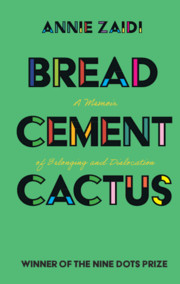
'Bread, Cement, Cactus': some reviews
Bread, Cement, Cactus: A memoir of belonging and dislocation is available in the USA, UK and in India, in print as well as in ebook format. You can buy the book at a bookstore or look it up online.
A free download is also available at the Cambridge University Press (UK) website.
"In the author’s world, there is space to learn from family and strangers, boatmen and historians, poets and gangsters. She paints a vivid picture of the people she encounters in person or hears about from others. If they come from a different set of life circumstances, she uses that moment as an opportunity to reflect on her own position in society based on gender, language, marital status, religion, parentage and property. This inward gaze is missing from a lot of political analysis about the current state of the country, and that is why this book stands out for its sincerity. It is not a rant; it is sensitive and sophisticated."
- The Hindustan Times
"Zaidi is keen to tell the stories of people who lose power, and then have to give up ground. The migrants who live on the margins; the Adivasis, who “displaced often, end up in cities where they are reduced to penury and homelessness”; and minorities, including Muslims who face bias in everyday life.
So, this safe place called home, does it exist? For her, a home is where she wants to return to, the heart being a compass. Sometimes, she thinks of home as morning mist, wispy and beyond her grasp."
"The disenfranchisement of women, anti-migrant and anti-Muslim rhetoric, ghastly incidents such as how the body of a Dalit person was airdropped from a bridge to avoid the upper caste section of a crematorium, and the British legacies that still enable the displacement of forest dwellers and exploitation of natural resources, are juxtaposed alongside personal meditations. At one point, the author recalls how an experiment of living on the urban poverty line of Rs47 a day, even as a person without dependents, made her quickly realise: ‘…all the things that lend me a feeling of home—language, history, memory—would dissolve into the overwhelming consideration of hunger. Food would be home.’
In prose that is admirably both poetic and compact, Zaidi creates in Bread, Cement, Cactus both a memoir of her own multiple belongings as well as a tract that sets out India’s various modalities of displacement. ‘Dislocation can be abrupt but the internal compass dissolves slowly,’ she writes. This book ponders not only that slow dissolution, but a subsequent reassembling too—but always, with the sober acknowledgment of fragmentations yet to come."
"In the author’s world, there is space to learn from family and strangers, boatmen and historians, poets and gangsters. She paints a vivid picture of the people she encounters in person or hears about from others. If they come from a different set of life circumstances, she uses that moment as an opportunity to reflect on her own position in society based on gender, language, marital status, religion, parentage and property. This inward gaze is missing from a lot of political analysis about the current state of the country, and that is why this book stands out for its sincerity. It is not a rant; it is sensitive and sophisticated."
- The Hindustan Times
"In the end, the architecture of the book attempts to lead us towards a counter-resolution that will establish home instead in the paradise of personal experience – in “the morning mist” for example – but this is never as convincing as the lasting sense of indignation and injustice that Zaidi evokes. “What belongs to whom?” she asks. “Who pays the costs of what is taken and cannot be returned?” These are questions perhaps more powerful than the answers Zaidi can provide, but it’s through questions such as these that she points towards the deeper mysteries of our human condition."
- The Guardian
- The Guardian
"Zaidi is keen to tell the stories of people who lose power, and then have to give up ground. The migrants who live on the margins; the Adivasis, who “displaced often, end up in cities where they are reduced to penury and homelessness”; and minorities, including Muslims who face bias in everyday life.
So, this safe place called home, does it exist? For her, a home is where she wants to return to, the heart being a compass. Sometimes, she thinks of home as morning mist, wispy and beyond her grasp."
- The Hindu
"Zaidi shines a light on the horror of what an androcentric society is, yet reiterates the concept of dislocation not only to emphasize the pain women go through but the healing and belonging they could find when following their own path."
"Zaidi shines a light on the horror of what an androcentric society is, yet reiterates the concept of dislocation not only to emphasize the pain women go through but the healing and belonging they could find when following their own path."
"The disenfranchisement of women, anti-migrant and anti-Muslim rhetoric, ghastly incidents such as how the body of a Dalit person was airdropped from a bridge to avoid the upper caste section of a crematorium, and the British legacies that still enable the displacement of forest dwellers and exploitation of natural resources, are juxtaposed alongside personal meditations. At one point, the author recalls how an experiment of living on the urban poverty line of Rs47 a day, even as a person without dependents, made her quickly realise: ‘…all the things that lend me a feeling of home—language, history, memory—would dissolve into the overwhelming consideration of hunger. Food would be home.’
In prose that is admirably both poetic and compact, Zaidi creates in Bread, Cement, Cactus both a memoir of her own multiple belongings as well as a tract that sets out India’s various modalities of displacement. ‘Dislocation can be abrupt but the internal compass dissolves slowly,’ she writes. This book ponders not only that slow dissolution, but a subsequent reassembling too—but always, with the sober acknowledgment of fragmentations yet to come."
Tuesday, December 29, 2020
Some thoughts on sanity, truth, violence and protest
I was interviewed recently by Saumya Kalia for Outlook magazine. One of the questions she put to me was taking off on something I said after my book Prelude to a Riot won the Tata Litlive Award for fiction.
I directed my comments towards the sponsors of literature festivals and book prizes, and the question and answer that follow build upon some of my thoughts:
"On winning the Tata Live book prize, you wrote about sponsored literary festivals and the motivation of the rich and powerful to get speakers to participate. For any society to remain sane, a little truth must survive, was your hypothesis. Can you explain what you mean by that?"
Me: The question of who sponsors art, and what art achieves in any society, has been troubling me for a long time. The vision of artists and their sponsors is often at variance. How does this relationship work, then? Artists are dependent on others, not just for their income, but also for spaces (physical, digital, metaphorical) wherein they engage with their audience. Picasso can make Guernica, but where will it hang? Will it survive if the powerful decide to get rid of it? Some of the greatest Renaissance art in Italy was commissioned by patrons like the Medici family, bankers and businessmen. Why did they bother? We have had stories told down the ages about kings and queens, their infidelities, filicides and parricides. Books, plays, oral storytelling arts were supported by the nobility or very wealthy merchants for most of our history. Why did they not insist on censoring all stories so that the nobility was only cast in benevolent light?
This might be for multiple reasons. One, truth itself is powerful. Those who wish to remain powerful must retain an acquaintance with the truth. They may serve disinformation to the rest of the country, but they themselves must have access to correct information. They may not invest in mass access to the arts, but they themselves must have access to the vision, the beauty and even terrifying clarity that artists bring. Two, lack of truth is associated with breakdowns of all kinds. What do we recognize as a loss of sanity? It is a state in which you can no longer tell what is real and what isn’t, what is harmless and what isn’t. Individuals who lose touch with the truth react in unpredictable ways. A society cut off from the truth, and from truthful art, starts to lose itself in similar ways. It becomes unpredictable and does not necessarily act in self-interest, much less underwrites someone else’s profit. Alternately, the truth goes underground, leaving the powerful in the dark and, this is worse for them. Look at any society where truth and art have been suppressed, and you will see that it is a sick/sickening society or a nation at war. I don’t think this state of affairs suits too many people, not for too long anyway.
The full interview is available here:
Thursday, May 28, 2020
New book
New book, published by Cambridge University Press. Out today.

A brief extract is available here:
https://ninedotsprize.org/extract-from-bread-cement-cactus/

A brief extract is available here:
https://ninedotsprize.org/extract-from-bread-cement-cactus/
Saturday, May 02, 2020
Because grief is not an event you can cancel
Behind all funerary efforts and expenses is the urgent need to confront the loss of someone with whom you had (and continue to have) a unique relationship. You acknowledge the person not just as blood and flesh but as someone who was at the centre of a distinct web of relationships, with a distinct place in this world. The food, the sharing of memories, the travel helped the bereaved move past the fact of a death and into the continuum of life.
During a pandemic, however, the last rites do not permit gathering and rallying around. Old friends won’t be sending floral tributes, or condolence cards. There will be no hugs. Grief will hover in the air. Like the virus itself, it might cling to your breath, hair, clothes, the undersides of your shoes.
Yet, grief is not an event. It can’t be cancelled, or even postponed. It has to be worked through, performed, acknowledged.
Please read this brief essay about coping and adapting to make room for grief (or joy) during the lockdown:
Subscribe to:
Posts (Atom)