Showing posts with label travel. Show all posts

Saturday, January 31, 2026

Essay: White sheets and white lies

Imagine then, my perplexity when I found myself trudging from hotel to hotel, baggage in tow, and my friend refusing to check in anywhere. The rooms looked fine to me, the hotels reasonably secure. What could be the matter? At the third hotel, my friend finally explained: she refused to stay at any hotel that didn’t have white sheets.

White bed linen. White towels. White robes. Code for luxury. All five-star hotels have them, and most four-star and three-starred hotels too, since they model themselves on the five-starred ones. But oh! The quiet boredom of five-star décor! Over the years, I have also written a few stories for travel magazines, which involved staying at five-star hotels with the implicit understanding between the editors and the hotels (who were also advertisers for the magazines) that the article should subtly nudge the reader towards the joys that were on offer. For a writer like me, this is a hard ask. Part of the problem is that I don’t like to do as I’m told, but even when I am willing, there’s the additional problem of not having much to write about. Every fancy hotel is more or less like another fancy hotel. They celebrate this monotony by putting out advertising jargon that describes the experience of staying at such hotels as ‘home’.

Now, my home is nothing like a fancy hotel. For starters, my sheets aren’t white...

Tuesday, August 08, 2023

Book alert!

Bantering with Bandits and Other True Tales (Aleph 2023) is just out. This is a new edition of Known Turf (2010), with a fresh Introduction chapter and a lot of footnotes that update the book's information with newer data, which lend it fresh context. 


This book of essays was nominated for the Crossword book prize in the non-fiction category when it first came out, and had a bunch of mostly good reviews when it first came out. It attempts to tell the story of our country in our times, with brief dips and detours into banditry, caste crimes, gender violence, displacement, hunger and malnourishment, faith and identity. All of these are, as I have learnt over the years, interlinked processes. I urge you to buy and read the book. 


Review links from 2010: 

"Annie Zaidi’s collection of essays, Known Turf, is arresting and unforgettable; about realities we prefer didn’t exist. Starvation deaths, female infanticide and communal intolerance step out of the anonymity of statistics to become people like us. They remind us of our defence mechanisms in the face of horror and sorrow; our efforts to stay sane and functional" - Karthika Nair in Tehelka

"Known Turf is a wonderfully engaging example of a puzzling trend in contemporary Indian writing in English. Despite the hype surrounding the novels-with-large-advances, the best writing today is happening in non-fiction." Alok Rai in Outlook

"Tragic and tender and brutal and funny." Known Turf covers a lot of turf.

"At its best, the book combines a reporter’s on-the-spot perception and a writer’s reflection and language to etch interesting, nuanced portraits of that half-mythical being in the throes of constant change: contemporary India. Known Turf is definitely worth reading, and not just for the sake of Gabbar Singh." Tabish Khair in Mint

"...anyone who has braved the railways without a confirmed reservation will get cathartic pleasure reading Zaidi’s graphic account of sitting on the corner of a seat, at a 45 degrees angle, with an RAC (Reservation against cancellation) ticket in a train to Lucknow" Alpana Chowdhury in DNA

"A book like this, written by someone who may once have been just as sheltered as they were, will resonate with Generation iPad in a way that a more world-weary account would bypass entirely." Manjula Padmanabhan in Outlook Traveller

"It’s a rare look into the lives of dacoits minus caricature.  Zaidi’s writing attempts to evoke an understanding of their reality.The Reporter and her Beat in Civil Society

"Among all the issues that Zaidi touches on, I find molestation to be the most moving. Though she puts in a lot of information on the other subjects she chooses, the whole force of her personality comes into play only when she starts speaking of molestation and eve teasing." From here

More reviews hereherehereherehere, and here.


Sunday, May 21, 2023

Sad Stories You are Old Enough to Hear

Eight years ago, I had my first essay accepted in the Griffith Review. 'Embodying Venus' was a meditation on women's bodies and (un)covering and the politics around it. There were a few more pieces in the journal since: 'Golden Girls' about the rise of young female wrestlers in India, 'Dangerous Little Things' about the significance of student politics, and a short story about ideological wars on Twitter, 'Cows Come Home'.

This year, again, I have a piece in their newest edition, Creation Stories. It is written in the form of a letter to a beloved young person who is growing up in fraught times: Sad Stories You are Old Enough to Hear


Dear A, 

The other day, I told you to stay out of it when two adults were talking about something serious. I saw your face, startled perhaps that this should come from me. I regretted it at once, partly because you are not a child. You are what we call ‘young adult’ in the world of literary endeavour and a young adult must be allowed into adult conversations. I know that my concerns may not be yours and perhaps even your sense of identity is not the same as mine. Perhaps you will be content to define yourself through pronouns or talent and no other struggle will be necessary. Still, we share blood, history and a love of stories, and I want to tell you some true stories today. Destabilising stories that offer neither resolution nor catharsis. Stories that go on, like an underground railroad loop inside your head. Stories that may explain the prickly, fragmented being you sometimes catch a glimpse of, before I clumsily gather myself. You will not remember it, but there’s a fragment of me permanently embedded on a railway platform in Mumbai...


The whole piece is behind a paywall but do read it here: https://www.griffithreview.com/articles/sad-stories-you-are-old-enough-to-hear/?fbclid=IwAR2xV0B2_KcjkLdCvNQH2TT9yRNNS697-_Slrq2GwCd43R5RKtlTFlC64hI 

Saturday, February 05, 2022

Happy Basant


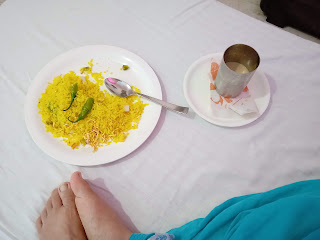
I was looking for a bright yellow photo to post on social media for Basant Panchami. Among my saved photos, I found this one. I am in a hotel room, on a research trip to Sirohi in 2019, for my book 'Bread, Cement, Cactus: A Memoir of Belonging and Dislocation'.

In most small hotels in central and western India and many parts of the north too, especially in district headquarter towns, small-ish hotels are the only option available to travellers. These tend to be usually business travellers rather than tourists or researchers. In such places, if you want tea or breakfast, you have to call the reception (if the room phone works) and ask for one of the employees to go to a local dhaba and fetch something to eat. The only option is poha (unless you want samosa or jalebi first thing in the morning, which I don't). You see my feet in the photo because I was sitting on the bed and eating. There was no table to eat at.

Here's to research, to travel, and to poha (although the featured poha in this photo was a sad little dish; I prefer it with lots of peanuts, potatoes, and even shredded chicken in mine).

Monday, February 01, 2021

'Bread, Cement, Cactus': some reviews

Bread, Cement, Cactus: A memoir of belonging and dislocation is available in the USA, UK and in India, in print as well as in ebook format. You can buy the book at a bookstore or look it up online. 

A free download is also available at the Cambridge University Press (UK) website.


"In the author’s world, there is space to learn from family and strangers, boatmen and historians, poets and gangsters. She paints a vivid picture of the people she encounters in person or hears about from others. If they come from a different set of life circumstances, she uses that moment as an opportunity to reflect on her own position in society based on gender, language, marital status, religion, parentage and property. This inward gaze is missing from a lot of political analysis about the current state of the country, and that is why this book stands out for its sincerity. It is not a rant; it is sensitive and sophisticated."


- The Hindustan Times 


"In the end, the architecture of the book attempts to lead us towards a counter-resolution that will establish home instead in the paradise of personal experience – in “the morning mist” for example – but this is never as convincing as the lasting sense of indignation and injustice that Zaidi evokes. “What belongs to whom?” she asks. “Who pays the costs of what is taken and cannot be returned?” These are questions perhaps more powerful than the answers Zaidi can provide, but it’s through questions such as these that she points towards the deeper mysteries of our human condition."

- The Guardian 


"Zaidi is keen to tell the stories of people who lose power, and then have to give up ground. The migrants who live on the margins; the Adivasis, who “displaced often, end up in cities where they are reduced to penury and homelessness”; and minorities, including Muslims who face bias in everyday life.

So, this safe place called home, does it exist? For her, a home is where she wants to return to, the heart being a compass. Sometimes, she thinks of home as morning mist, wispy and beyond her grasp."

- The Hindu


"Zaidi shines a light on the horror of what an androcentric society is, yet reiterates the concept of dislocation not only to emphasize the pain women go through but the healing and belonging they could find when following their own path."


"The disenfranchisement of women, anti-migrant and anti-Muslim rhetoric, ghastly incidents such as how the body of a Dalit person was airdropped from a bridge to avoid the upper caste section of a crematorium, and the British legacies that still enable the displacement of forest dwellers and exploitation of natural resources, are juxtaposed alongside personal meditations. At one point, the author recalls how an experiment of living on the urban poverty line of Rs47 a day, even as a person without dependents, made her quickly realise: ‘…all the things that lend me a feeling of home—language, history, memory—would dissolve into the overwhelming consideration of hunger. Food would be home.’

In prose that is admirably both poetic and compact, Zaidi creates in Bread, Cement, Cactus both a memoir of her own multiple belongings as well as a tract that sets out India’s various modalities of displacement. ‘Dislocation can be abrupt but the internal compass dissolves slowly,’ she writes. This book ponders not only that slow dissolution, but a subsequent reassembling too—but always, with the sober acknowledgment of fragmentations yet to come."


Thursday, May 28, 2020

Saturday, May 02, 2020

Because grief is not an event you can cancel


Behind all funerary efforts and expenses is the urgent need to confront the loss of someone with whom you had (and continue to have) a unique relationship. You acknowledge the person not just as blood and flesh but as someone who was at the centre of a distinct web of relationships, with a distinct place in this world. The food, the sharing of memories, the travel helped the bereaved move past the fact of a death and into the continuum of life.

During a pandemic, however, the last rites do not permit gathering and rallying around. Old friends won’t be sending floral tributes, or condolence cards. There will be no hugs. Grief will hover in the air. Like the virus itself, it might cling to your breath, hair, clothes, the undersides of your shoes.

Yet, grief is not an event. It can’t be cancelled, or even postponed. It has to be worked through, performed, acknowledged.

Please read this brief essay about coping and adapting to make room for grief (or joy) during the lockdown:

Thursday, April 02, 2020

When hunger is the tragedy...

My mother attempted to buy vegetables last week, right outside the gates of the housing complex, and she witnessed police officials preventing sales. A cart or basket had been overturned. Vegetables lay crushed in the dirt. She saw desperate folk picking up the damaged food when they thought the cops were not looking. Her recounting of this brief experience triggered something within me. That, and reports of migrant workers – suddenly out of work, hungry, and trying to walk hundreds of kilometres on foot.

I began to think of ‘The Song of Famine’, a long chapter embedded within a travelogue written by the French traveller Pierre Loti. India was published in 1901, just after a major famine had affected many parts of the country, Rajasthan in particular.

In the city of Jaipur, Loti documented what he saw:

“Servants lead tamed cheetahs belonging to the King through the streets. These are led on slips so that they may become accustomed to crowds, wear little embroidered caps tied under their chins with a bow…But there are also many hideous vagrants— graveyard spectres like those lying at the rampart gates. For these have actually dared to enter the rose-coloured city and to drag their skeletons through the streets. There are more of them than I should have thought possible…horrible heaps of rags and bones lying on the pavements hidden amongst the gay booths of the merchants, and people have to step aside so as not to tread upon them. These phantoms are peasants who used to live in the surrounding districts. They have struggled against the droughts which have brought destruction to the land, and their long agony is imprinted on their incredibly emaciated bodies. Now all is over; their cattle have died because there was no more grass, and their hides have been sold for a mere trifle. The fields which they have sown are only steppes of dusty earth where nothing can grow, and they have even sold their rags and the silver rings that they used to wear on their arms and ankles so that they might buy food…They thought that people would take pity on them, and would not let them die, and they had heard that food and grain were stored here, as if to resist a siege; they had heard, too, that every one in the city had something to eat. Even now carts and strings of camels are constantly bringing sacks or rice and barley that the King has procured from distant lands, and people are piling them up in the barns, or even on the pavements, in dread of the famine which threatens the beautiful city on every side. But though there is food it cannot be had without money…”


I began to read this chapter again once pictures and videos began to emerge of migrant workers and their families trying to leave cities after A sudden lockdown was announced to combat the ongoing Corona virus pandemic. People are heading back to villages where they hope to be fed. Perhaps they could live off the fruits of the land, if they have any, for a while. Perhaps they could shelter in a hut that’s not in an overcrowded slum. At the very least, if they die, their families will know what happened.

Read the full article here:

Tuesday, July 30, 2019

Ertugrul in the age of Erdogan

As a child, I had thrilled to the story of a powerful, warrior woman on the throne of Delhi but had never wondered about who her ancestors were. I had not thought of medieval Turks as nomads, casting about in whirlpools of contested nationalities. In the modern Indian imagination—especially the Hindutva narrative—Turks are seen as usurpers of power, lumped with Persians, Chagtais and Mongols like Changez Khan who was the Oguz Turks’ biggest foe. Through watching Resurrection: Ertugrul, I began to see them as landless tribes whose only chance at life was a strong sword arm.

The world these characters inhabit is an intensely cosmopolitan one. The bazaars, inns, port towns are melting pots of race and civilisation. The actors come in all shades of brown, reflective of the mixed Greek, Roman, Armenian, Arab, Assyrian and Moroccan ancestry in the region. Watching them I felt something shifting but it took me about a hundred episodes to understand what it was. It was the stone of cultural imperialism and it weighed a few centuries... our awareness of the greater world was minimal—everything between Bombay and Britain was an indistinct blob in our minds. Millions of South Asians worked in the Gulf but we didn’t know its history. We read about Iraq’s invasion of Kuwait in 1990; the newspapers mentioned the decade long Iran-Iraq war before that. But we didn’t know how Iraq and Kuwait came to be on the map.

All I knew about Turkey was a couple of lines in my history textbook: The Indian struggle for independence was entwined with the Khilafat movement, which opposed British attempts to strip the Caliph of all power. Mustafa Kemal Ataturk defeated colonisers and made it a secular nation.

In fiction, I read about King Arthur, Joan of Arc, Papal politics. I read about the Crusades and knew that these were wars fought between Christian knights and Muslim hordes. The knights, I thought of as vaguely noble: knight in shining armour; knight to the rescue of damsel in distress; knight on a white horse; people “knighted” after great achievements. The Muslim hordes, I thought of as... The truth is, I did not think about the Muslims at all.


Read the full text of my essay on cultural politics, Netflix, and the shaping of minds via storytelling and media exposure in Fountain Ink magazine : 

Thursday, March 14, 2019

A splendid road


If you run an online search for good roads in India, you might come upon a question someone asked on Quora: Why aren’t the roads in India as good as the roads in Pakistan?

It is, like all things India-Pak, a touchy question that draws spirited responses from both sides. People have posted pictures of the best, smoothest highways from across the two countries. There are photos of rain-washed vistas, Marine Drives, sun-kissed or snow crusted mountain roads. There was Mumbai’s famous sea link and the distinct curliques of the Lahore ring road. All these roadways looked quite splendid and it took me a while to figure out the secret of their beauty – it was the fact that there wasn’t much evidence of traffic. In other words, roads look great as long as they aren’t being used.

I’ve been thinking ever since about the beauty of modern cities, and our ideas about it. In every pretty picture posted of a great road, there is little or no vehicular transport visible. The photos suggest quiet, openness, easy access. Looking at those photos, you feel you could go anywhere at all, and nothing could stop you.

Where motor vehicles are visible, they have been carefully framed so that you see just one truck, or a handful of cars seen from a distance on a road that, in South Asian cities, would most likely be choked by a few hundred cars at any time of the day.

The more impressive photographs are taken aerially. But who among us ever gets to look at our roads from an aerial perspective? What we see of our own roads is, in the day time, a sea of car bumpers, and a moving river of light at night. If you want to live the fantasy – open, empty, wide road, smooth enough that you want to gulp it down – you have to be out between midnight and dawn, when you can hardly see anything of the city.

Apart from emptiness, there is one more thing that makes roads appealing: nature. Trees and flowers, lakes and canals. Water in any form immediately improves the picture. So does a touch of green hanging overhead. Roundabouts and road dividers look positively cheery when blooming with bright pinks and yellows.

Trees and flowers can make any street corner look appealing. Put an untarred road next to a big, green park and chances are, you won’t notice the quality of the road’s surface.

Just looking at such photos should tell us how to make urban lives beautiful. We need to plan the city around water, and to create large waterscapes in and around the city if they do not occur naturally. We need to limit motor transport. Above all, we need trees.

It goes without saying, of course, that trees and flowers cost time and money to maintain. It also goes without saying that this sort of expense is not spared in the enclaves of the rich, although a lot of this beauty is funded by ordinary citizens. Delhi is beautiful in late winter and spring, but much of this beauty is limited to the corridors of power – the diplomatic enclaves, the President’s residence, the ministerial bungalows.

On another Quora thread comparing India and Pakistan, commentators have truthfully said as much, that village roads in both countries are mostly bad, that expressways on both sides look much the same, and that the roads serving “VIP houses” are excellent. There is little need to say more. The beauty and limited access of VIP enclaves contains every other truth.  


First published herehttps://www.thehindu.com/life-and-style/motoring/empty-roads-look-nice-but-trees-and-flowers-make-them-look-better-even-if-they-are-potholed-and-untarred/article26508097.ece

Friday, February 15, 2019

A new mobile fantasy


I don't know what made me think of pedal-boats. Perhaps it was the whiplash of January rain. Perhaps it was the feeling of being cramped and under-exercised. Recently, I began to think of how much fun it would be if cars could run on a pedal principle, the way boats can.

It would also a good way to hold onto an old motor vehicle, especially one whose body is more or less fine but which isn't going to fetch significant money in the used car market. What if the body was retained, the tyres re-aligned and fixed up to connect to peddles that the driver would use?

When I said this out loud, I was politely informed that it was an impractical idea. One would have to do a whole lot of furious peddling to get anywhere, and even if one did have the muscular stretch to push the car a few kilometers, one would hold up the rest of the traffic.

I personally think it is a sensible idea. Certainly, it is more practical than burning up gallons of fossil fuels, bankrupting the planet, causing the air of all our cities to become toxic, and making little kids sick.

A car-cycle wouldn't hold up traffic just as bicycles don't. Fossil fuelled motors could be given one dedicated lane. If cities can conceive of bicycle or bus lanes, we can also conceive of car-cycle lanes. It would cut down fossil fuel use. It might even help cultivate a culture of sticking to dedicated lanes if vehicles that look like regular cars and just as big were to occupy a wider pedal lane.

I looked up the idea online and found people were thinking along similar lines. In North Carolina, USA, there exists a hybrid vehicle called ELF (Electric, Light, Fun). It's a tiny three-wheeler, a bit like our battery rickshaws, except the tyres are more like bicycle tyres and it is pedalled by the driver. News reports suggest it can do 20 miles an hour. It is also fitted with a solar panel that powers an electric motor, which can push speeds upto 35 miles an hour.

Cars are re-purposed in strange ways, like cutting them up into halves, pulling out seats and turning them into furniture that's unlikely to appeal to anyone except motor fanatics. If we could instead use car bodies to make pedal mobiles, it would solve many problems. People may like to bicycle around cities, but must sometimes take along older people or children. A car-cycle would be good for them. There could be a dual pedal system too, as in boats, so the physical work can be shared.

It would be useful for bad weather. A bicycle, or even an auto-rickshaw, exposes you to rain and cold winds. India's summer sun makes bicycling an unpopular idea. A car-cycle would protect you from sunburn and keep you fit. You would no longer need to pay for gym memberships, nor would you have the excuse that long commutes interfere with workouts. The car would be the gym!

It is worth attempting, especially on campuses and in industrial parks where car use should be limited in any case. I, for one, would be up for a test drive.


First published here: https://www.thehindu.com/life-and-style/motoring/how-about-upgrading-our-pedal-power-endeavours-to-the-level-of-cars/article26183637.ece?fbclid=IwAR0y-BMfIrMgZIP8Vy5ZHxeu8XqSI0iXkndQ0AxyxKwpj_El8lQUrIoVT2w

Saturday, February 09, 2019

A mobile fantasy


I don't know what made me think of pedal-boats. Perhaps it was the whiplash of January rain. Perhaps it was the feeling of being cramped and under-exercised. Recently, I began to think of how much fun it would be if cars could run on a pedal principle, the way boats can.

It would also a good way to hold onto an old motor vehicle, especially one whose body is more or less fine but which isn't going to fetch significant money in the used car market. What if the body was retained, the tyres re-aligned and fixed up to connect to peddles that the driver would use?

When I said this out loud, I was politely informed that it was an impractical idea. One would have to do a whole lot of furious peddling to get anywhere, and even if one did have the muscular stretch to push the car a few kilometers, one would hold up the rest of the traffic.

I personally think it is a sensible idea. Certainly, it is more practical than burning up gallons of fossil fuels, bankrupting the planet, causing the air of all our cities to become toxic, and making little kids sick.

A car-cycle wouldn't hold up traffic just as bicycles don't. Fossil fueled motors could be given one dedicated lane. If cities can conceive of bicycle or bus lanes, we can also conceive of car-cycle lanes. It would cut down fossil fuel use. It might even help cultivate a culture of sticking to dedicated lanes if vehicles that look like regular cars and just as big were to occupy a wider pedal lane.

I looked up the idea online and found people were thinking along similar lines. In North Carolina, USA, there exists a hybrid vehicle called ELF (Electric, Light, Fun). It's a tiny three-wheeler, a bit like our battery rickshaws, except the tyres are more like bicycle tyres and it is pedaled by the driver. News reports suggest it can do 20 miles an hour. It is also fitted with a solar panel that powers an electric motor, which can push speeds upto 35 miles an hour.

Cars are re-purposed in strange ways, like cutting them up into halves, pulling out seats and turning them into furniture that's unlikely to appeal to anyone except motor fanatics. If we could instead use car bodies to make pedal mobiles, it would solve many problems. People may like to bicycle around cities, but must sometimes take along older people or children. A car-cycle would be good for them. There could be a dual pedal system too, as in boats, so the physical work can be shared.

It would be useful for bad weather. A bicycle, or even an auto-rickshaw, exposes you to rain and cold winds. India's summer sun makes bicycling an unpopular idea. A car-cycle would protect you from sunburn and keep you fit. You would no longer need to pay for gym memberships, nor would you have the excuse that long commutes interfere with workouts. The car would be the gym!

It is worth attempting, especially on campuses and in industrial parks where car use should be limited in any case. I, for one, would be up for a test drive.


Published here: https://www.thehindu.com/life-and-style/motoring/how-about-upgrading-our-pedal-power-endeavours-to-the-level-of-cars/article26183637.ece

Thursday, January 10, 2019

Unacceptable, but so very accepted

If I was a builder who built a sub-standard building that collapsed and killed a few people, or if I was an engineer who inspected and certified such a building as safe, I would be arrested. If I was not very rich, I would probably do some jail time too. I think it is also safe to assume that the state would chip in and offer compensation for the deaths. It does so in cases of accidents, fires, or bridges falling.

Funny, then, that a city should simply shake off responsibility when its own municipality is directly responsible for the safety and maintenance of the space. The failure to maintain roads can, and does lead to deaths. But somehow, these deaths do not lead to an outcry, or calls for justice and affixing of culpability, the way a building or bridge collapse death would.

The Hindu reported recently that, between 2013 and 2017, close to 15,000 Indians had died in accidents caused by potholes. Other reports suggest that the government has admitted to over 9300 deaths and 25000 people being injured because of potholes over the last three years. Our Supreme Court has described this situation as “unacceptable”.

Mumbai, with its nearly five month monsoon spell, is especially vulnerably to pothole-related damage. In July this year, a young motorcyclist was killed when his bike fell after hitting a pothole. Just days before, two other pothole related incidents were reported, one involved a pedestrian and another a mother-of-two whole was riding pillion on a bike.

Earlier this month, the Brihanmumbai Municipal Corporation (BMC) flatly refused to pay compensation to victims of road accidents, even if these deaths were caused by potholes. A corporator had demanded compensation, in response to which, the BMC said that the roads were the responsibility of the contractors.

In November, a woman and a six month old baby were reported killed when the bike they were riding pillion on skidded on a potholed road in Dadar. The family of four on the bike was thrown off and crushed by an oncoming water tanker. Oddly enough, the police thought it fit to arrest the tanker driver, but not to take any action against those who are responsible for filling potholes on the roads.

The BMC has not responded well to criticism of its handling of the pothole situation. When radio jockey Malishka spoofed the “Sonu” song, calling it the “Pothole Mix”, changing the lyrics to describe the mess the city is reduced to during the rainy season – potholes, water-logging, traffic and stalling of trains. The Shiv Sena and its corporators responded with outrage, suggesting that she be sued for 'defaming' the municipal body. Eventually, the BMC did send a notice to the RJ's mother, for “dengue breeding” at home.

Perhaps the corporators need to take some lessons from Mumbaikar Dadarao Bilhore. In 2015, his teenage son died in a pothole related accident. By June 2018, the grieving father had managed to fill up 556 potholes. He did express the hope that the BMC and MMRDA would look at people and be inspired to do a better job.

Mr Bilhore has shown that it can be done quickly and efficiently. It is, nevertheless, a great tragedy that heartbroken citizens should have to do a job for which taxpayers are already paying municipalities and their contractors. Perhaps the courts need to do more than say “unacceptable”.


First published here: https://www.thehindu.com/life-and-style/motoring/road-accidents-do-not-seem-to-raise-the-same-chorus-of-clamour-other-tragedies-befalling-the-general-public-do/article25879817.ece

Saturday, December 22, 2018

Double sighted


Double sighted

After years, I hopped onto a double decker bus. I'm not sure why I say “hopped”. Hopping was as unlikely as gracefully waltzing in. A more accurate thing to say would be that I lunged desperately at the bus and that, somehow, I didn't fall. That I was forced up the stairs and onto the upper deck because there was nowhere else to go. That I managed to sit for ten minutes, surrounded by weariness and careful impassivity, until someone shifted and the possibility of a seat emptying broke the spell.

Trying to keep my own face impassive, feeling the crowd thicken, breathing in infinite disappointment and anxiety, I felt as if I had to grow another skin at once. A skin thick enough to prevent an osmosis of mood and mein.

Those who stop taking buses and trains forget what the city feels like for most. I do use public transport a lot but have stopped commuting during peak hours. That evening, I hadn't planned on boarding a bus, but it was after five and Cuffe Parade was spewing out line upon line of office-goer. Since no cabs were free, I went to the bus stop and thought: I've done this; it's not all that hard. Besides, Mumbai's BEST services are really quite decent, and so on.

It was hard. The bus was so full that if I kept my seat on the upper deck, I'd never make it down to the lower deck when my stop arrived. There were people crammed all the way up the steps. So I went down to the lower deck, and discovered I had nothing to hold onto. No grab rails or strap-hangars where I found a spot to stand. With the bus braking and lurching every few seconds, it was near-impossible to keep my balance. Yet, the near-impossible was achieved through sheer force of will and several muscles working in tandem. It was a militant form of yoga.

Now I was forced to remember why I had sworn to myself that any life plan – anything at all – had to be better than this. Surely, my life couldn't be reduced to a degree of stiflement so that I'd rather risk my life standing on the footboard than being squashed on all sides by a crowd, even if that crowd is all female? I wouldn't be reduced to the sort of pettiness that makes the most generous spirits lunge at seats and argue about who is entitled to sit down first?

As the bus turned towards the promenade, I caught a glimpse of the setting sun glancing off grey water. It was a tiny hint of mercy. For a minute, I breathed easier. Then I found anger. This wasn't just bad, it was much worse than it used to be. The slow bleeding of the BEST has meant fewer buses, older buses, never enough buses on busy routes. Taking away chunks of fairly profitable public sector companies – such as electricity supply – and handing it on a platter to private firms has meant that public transport can't be subsidised the way it was. The continual focus on cars has meant more roads, bridges and sea links to cut down on traffic time, but never any dedicated bus lanes.

Outside the bus, I spotted foreign tourists taking selfies. I wondered whether they thought of this as a good city. Of us, as a happy people. Look at us! Smiling through it all even as we hang off the sides of a rickety bus. Look at us, coping. Suddenly, I wanted to shake a fist at someone.


First published here: 

https://www.thehindu.com/life-and-style/motoring/a-ride-on-a-double-decker-bus-in-mumbai-gets-the-author-thinking-about-public-transport/article25717732.ece

Friday, November 30, 2018

A traffic legend

Can’t say I wasn’t warned. Friends who’d been to Dhaka before told me not to make elaborate plans; the traffic wouldn’t allow me to get around much.

I thought, but traffic is pretty bad everywhere. Delhi, Mumbai, Bengaluru... How much worse could Dhaka’s traffic be? Well, let’s just say that it lived up to its reputation.

I was participating in the Dhaka Literature Festival and discovered that the tiniest commute required a few hours of traffic time. It took an hour to drive a stretch that one could walk in 20 minutes. When the car did move, it didn’t move smoothly. Other writers, especially those who were not used to the chaos of the Subcontinent, were made nervous by the jerky, forward-sideways style of progress. Coming from India, I knew there was little danger at those speeds.

However, speeds are not always so slow and there is always some danger. Dhaka discovered this in recent months, after an accident led to a major political confrontation. The city was brought to a standstill by teenagers, after two school students were killed through rash driving and several were injured.

Accidents are a major cause of death in South Asia. India reportedly witnesses 400 fatalities every day, and road accidents are one of the top 10 causes of death in the country. But in Dhaka, something else was brewing. Students weren’t just protesting the deaths of two kids. They were also reacting to everything else that’s wrong on the road. Nobody observes any rules; there’s no lane discipline. There aren’t enough state-owned buses. Private transporters, many of them politically connected, don’t train drivers properly. Most bus and car drivers are very poorly paid and have no job security. Many of them don’t even have licences.

Children were trying to shame the police into doing their job. They turned out in school uniforms and set up ‘check points’ where they checked licences, scolded traffic violators, demanded that the traffic cops take action. Soon, the movement got bigger. University students joined the protests and now the government became anxious. College students tend to be more politically aware.

Perhaps, the government was afraid that opposition parties would capitalise on the student agitation — and there is a lot to be agitated about — or perhaps the leadership just didn’t know what to do with their demonstration of anger. The outcome, anyway, was the police aggression. Some ‘clashes’ were reported, but some of the violence was allegedly caused by youths affiliated with the ruling party. Photos and videos of the attacks were a further embarrassment for the government.

Again, instead of engaging or promising appropriate action, the state tried to stifle all criticism. Photographer Shahidul Alam was arrested and charged with making ‘provocative comments’ after he shared a video on Facebook and talked to Al Jazeera about the reasons for the protests. He’s out on bail now, but the charges haven’t been withdrawn.

All that time I was stuck in that infamous traffic, I chafed. Why are we obsessed with motor transport in over-populated cities? Why don’t our governments move to fix problems before the tipping point arrives? Why don’t we incentivise cheap, eco-friendly modes of transport like bicycles? Someone cribbed about cycle rickshaws slowing down Dhaka’s traffic, but that isn’t true. The sensible thing would be to create dedicated cycle and cycle rickshaw lanes to streamline flow, and to make sure that students and the poor don’t get hurt.

All it would take is for the leadership to be open to dialogue, to not panic in the face of criticism, to not suspect people’s motives. They elected you, after all. Didn’t they?

Sunday, October 07, 2018

Grave matters

The paths of glory, a poet has said, lead but to the grave. What the poet may not have imagined is the path that leads to the actual graves of famous writers. Certainly, Thomas Gray would have had some experience of inglorious pathways. Nineteenth century England was no stranger to rubbish dumps and the poet would certainly have corresponded with the occasional turd, an open sewer, or a bit of bone sitting quietly in narrow alleys. One must go down one such a lane to reach the grave of Meer Anees, one of the most celebrated Urdu poets.

This part of Lucknow is not unlike the ailing heart of India's grand old cities. The streets are narrow, the houses crumbling, and infrastructure is rather hit and miss. To visit Meer Anees, you'd make your way to Chowk, and then to a small, elegant mosque called Tahseen wali masjid. You'll find a book shop at street level (and dark whispers of a campaign to force the owners out of business through the persistent dumping of rubbish above) and then a lane as narrow as the waist of a beloved, though less perfumed. You'd do well to send word to the descendants of the poet before you found the grave.

Anees was buried on private land and though a considerable tomb has been built, it is encircled by a metal fence and the door leading to it is locked. Apparently, “anti-social” elements had begun to frequent the place, so locking up was the simplest way to keep them out.

What made me really sorry, though, was that there wasn't a signboard in sight to point tourists and lovers of literature in the right direction.

On my first visit to London, I had very little money and not much time to look around. However, I was determined to take in a visit to Charles Dickens' house. The writer had shaped more than just my literary tastes; he also gave me a moral view of the world and, in that sense, his work finds a home in me. Even so, I wanted to see one of the houses he lived in. It was listed on the tourist map and there were at least three street signs pointing the way. But more than three were not permitted by the city and, to my dismay, I realised that a fourth sign was desperately needed.

After wandering in circles for an hour, I nearly gave up. No passersby helped; many seemed not to know who Charles Dickens was! Eventually, I stopped to buy water at a department store where a schoolboy came to my rescue.

In India, we tend not to preserve writers' homes as living monuments. The houses are inherited by families who can't always afford to preserve them. Even so, it would be useful if the state put up a few signs that informed and encouraged visitors who came looking for the city's cultural heritage.

At any rate, a culture that celebrates poetry is neither built in stone nor buried in stone. It is found half lying in a bright yellow kurts, smoking a cigarette with the mosque to his left, garbage dump to his right, and couplet by Anees on his ready lips.

I have now forgotten the verse he sent up into the overcast afternoon. But another will serve just as well: 
Ahtiyat-e-jism kya, anjaam ko socho Anees
Khaak hone ko ye musht-e-ustukhwan paida hue

Worry less about this body, Anees, think of what comes after,
This bag of bones was meant to be ground into dust.


First published here: https://www.thehindu.com/todays-paper/tp-features/tp-metroplus/grave-matters/article24982723.ece

Friday, August 24, 2018

Bus ladies

A few months ago, I had the good fortune of being invited to the Women of the World Festival, held in Brisbane this year.

Because it focusses on women – as artists, creators, activists, change-makers, musicians, amateur wall-climbers – it also hires mainly women. It is no longer unusual, of course, to see women hosting and organising events, marketing and managing ticketing counters and so on. However, it is still unusual to find women chauffeurs. What's rare is the sight of a woman driving a mini-bus. What's rarer than that is to board a bus and expect a woman behind the wheel. In Brisbane this year, I had this rare experience.

Around the world, at cultural or artistic events, the people who are driving guests to and fro the venue are often volunteers. They inhabit the city and would like to participate in its cultural life. Perhaps they get a little stipend too, but they are not professional taxi drivers. They are students or aspiring managers or just people who have a bit of spare time on their hands.

Even so, the first time I found a young woman at the wheel of a mini-bus, I was pleasantly surprised and I also thought that she must be an unsual woman. Maybe she has experience handling big vehicles. Then I realised that all the volunteers were women and they were all driving these huge vehicles. So I got talking.

Some of them turned out to be students at one of the local universities. They also had other jobs. None of the ladies I talked to drove big vehicles regularly. This was a new experience for them. They admitted that it looked a bit daunting at first, but also said that they felt confident handling the vehicle after the first day. They were cheerful, besides being good, careful drivers and I couldn't have felt happier or safer out in a strange city than knowing that the bus I was waiting for was being driven by a woman.

Back home, of course, this is not an experience I have had. I did bump into a female auto-rickshaw driver once in Delhi, but that was nearly a decade ago. I take hundreds of rickshaws every month in cities like Delhi and Mumbai but I have never again found a female driver. A few years ago, I found myself in Rohtak, and I spotted a few pink share-rickshaws. Curious, I hired one all by myself. It was driven by a young teenaged boy but a saree-clad matronly woman was seated up front beside him, on the driver's seat.

I asked whether the rickshaw was actually the woman's and she confessed it was given to her under some state scheme, meant to encourage women's employment. The boy was a family member, though, and she said she let him drive it most of the time.

I can't help thinking how different our world would look if, every time we hailed a cab or waited at the bus stop, we wouldn't know whether the hands on the wheel were going to be men or women. What if there was a fifty-fifty chance? And what if women didn't have to announce their presence on the streets by painting everything pink every time they got behind the wheel?


First published here: https://www.thehindu.com/life-and-style/motoring/getting-behind-the-wheel/article24744774.ece

Monday, July 16, 2018

A button jab worth of equality


One of my favourite experiences while traveling in more developed nations is the button you can press whenever pedestrians want to cross the road.

I love those buttons affixed to poles at every crossing. They makes a pedestrian feel like she's something too. Something resembling a human citizen rather than a scurrying insect trying to get out of the way of unseeing, unstopabble metal beasts. It makes you feel like your life is a little bit more valuable than ten seconds in the lives of people who happen to be in cars. It reminds you that you are equally human and the fact that you're using your own two feet to get around makes you more deserving of consideration, not less.

This thing about bicycles and sidewalks and the constant dismissal of pedestrians as a component of street traffic – it's basically a class problem in India. There are hierarchies in developed nations too, but the class groups aren't watertight compartments. Those who drive cars also ride bicycles and also take long walks. Those who walk to work may well possess cars, choosing to drive only on weekends. People may drive to work but prefer to walk to restaurants or clubs in the evening.

In India, class is a visible phenomenon. Usually, the pedestrian is at the bottom of the heap. She, or he, does not own any motoring assets. And so, what right have they to expect that they can actually cross the road safely? And if they do cross, they must do so at their risk, and only after a patient wait at the traffic lights. They certainly don't get to control how long they must wait, or how much further they have to walk before they can find a proper zebra crossing and a traffic light?

Those who ride bicycles often cannot afford motorcycles or scooters or cars. Cyclists are mainly men running errands, not doing it for pleasure or exercise. Errand boys, tradesmen, freelance professionals may be carting packages as heavy as their own body weight. They could also be young students from middle class families but increasingly, in bigger cities, students take buses, trains, or rickshaws.

The adult middle class cyclist is an anomaly in India (I know of only six such among several hundred friends and acquaintances). I also remember the time when one of them was barred from entering a complex where discussions and arts' events are hosted. He was riding a bicycle and clearly didn't fit the security guards' image of someone who deserves to access art or join interesting conversations about society. It wasn't until he began to argue in English that class privilege was re-established and the guards relented.

Nowadays, some states are talking of barring cyclists and cycle rickshaws from major roads. There is not much noise about this, so I am guessing that most middle class people would prefer it that way. Or would they?

There must be a knot of worry in upper class hearts about bad times. What happens if they cannot afford chauffeurs to ferry kids to school and drive retired parents to hospitals? Will they have to find worse ways of making more money to pay for cars and fuel and chauffeurs, and houses with more parking space? What if all investments backfire? Will the kids die, trying to cross a road?

Surely, even the elite must prefer the idea of a country where such questions weren't necessary.


Monday, May 28, 2018

Not quite highway robbery


One of my enduring memories from the first time I visited Melbourne is walking around looking for lunch and spotting a compact row of bright blue bicycles that were neatly stowed on the sidewalk.

The first question that popped up in my mind was: “How come everyone here rides the exact same bicycle?”

A moment later, I felt sheepish. I realised that it was a bike rental system. Precisely the kind of system I wish upon all cities. At home, of course, it is unlikely to work. First of all, there are no cycling lanes. When the national capital, Delhi, tried to create a cycling track along one stretch of BRT (a rapid bus transit lane) a few years ago, it was promptly hijacked by motorcyclists and auto-rickshaws. A few small cars tried to squirm in as well. Cops had to be stationed there to catch and fine three and four wheeled drives. It never was possible to fine scooters and motorbikes – because they insisted that they interpreted the bicycle symbol for the lane as a 'two-wheeler symbol'. At any rate, the BRT system was dismantled and the exclusive bicycle track vanished. Currently, bikes ride on the pavements.

Secondly, there's a good chance the bicycles would get stolen. We'd need to station cops or guards to make sure people paid rent and returned them.

I wanted to ask my friends in Melbourne: “How come your bicycles don't get stolen?” But it felt like a foolish question. Maybe they had some technology to track down stolen bikes. Or perhaps, bicycle theft simply wasn't worth the trouble and the risk of prosecution.

In India, of course, bicycles are useful, not just as a vehicle but also a potential source of scrap metal. And there are a great many people who take great risks for very little gain. That same year, there was a robbery in my uncle's house. One of the employees' bicycles was stolen at night, despite high boundary walls all around. The local security guards' bicycles had also been stolen a few nights before, so they had been keeping their eyes peeled. The thief was soon caught red-handed. He had made the mistake of returning to the same street to steal some iron rods that were lying outside a house.

Anything that's sitting on the road, or even just inside one's own property, if it's easily accessed from the road, is likely to tempt some desperate citizen. Iron rods aren't worth a lot of money – definitely not worth time spent in prison – and yet, people try to steal them. Metal drain covers are stolen sometimes. Dustbins aren't spared either. In Mumbai, I have seen elevated metal bins with their bottoms cut out. Metal tumblers are often chained to free drinking water outlets, so people don't walk away with them. Tumblers in train toilets are chained to taps. The taps in public toilets get stolen too.

I once lived on a street where the slabs of stone that covered an open drain were stolen. That monsoon, we were all wading through overflowing sewage.

I don't know how much a slab of stone costs. Nor do I know what it costs to cover drains. But one thing I do know: wading through sewage is an experience that diminishes your self-esteem. And thinking about the man who steals drain covers for a living, being caught and put in jail does not make you feel any better.


First published here: http://www.thehindu.com/todays-paper/tp-national/tp-mumbai/not-quite-highway-robbery/article2389864.ece3

Sunday, May 20, 2018

Trolling via road nomenclature

The naming of streets is a tricky business. In the old days, streets got their names off occupations. There could be named after a Baker, a Butcher, a Shoemaker. Or, after prominent landmarks, like Church Street. In India, we have our own versions, such as Chikoo-wadi, Parathe-wali Gali, Dariba Kalan or Chandni Chowk.

The naming of streets after people is a relatively recent phenomenon and quite a politic decision. To name a street after a person, with the assumption of perpetual visibility, is to say that this person is significant, and must remain in public memory. And therefore, we have streets named after monarchs, politicians, scholars, artists and very prominent businessmen. Very, very rarely do we have a street named for an activist. There is of course, Mahatma Gandhi; several Indian cities have an M.G. Road by way of acknowledging the father of the nation. One could say he was an activist-politician. However, the more confrontational and anti-establishment an activist is, the fewer the chances that his/her name will be enjoined to a street sign.

Unless, of course, it's someone else's activist. Those are easier to champion.

Recently, Dutch activists went about “renaming” streets after Ahed Tamimi, the Palestinian teenager who was imprisoned for hitting an Israeli soldier. What makes it a fine act of diplomatic trolling is that one of these street named for Ahed leads to the embassy of Israel in Amsterdam.

I do not know whether The Netherlands officially supports such a renaming but, at any rate, the state seems not to be in a hurry to punish the activists who made the change.

Such trolling of another state via renaming of the street on which the embassy stands is not new. Iran did this masterfully way back in 1981.

Bobby Sands was a member of the Irish Republican Army which was opposed to British rule. Sands was in prison and had undertaken a hunger strike along with a handful of other IRA activists. He withstood the strike for 66 days before he died at the age of just 27.

In May 1981, news of his death filtered out to the rest of the world. He had many supporters, even as far as Teheran. The Iranian government decided to honour his memory – and stick their tongue out at the British – by renaming the street on which the British Embassy stood.

The UK officials, naturally, was not amused; they thought of the IRA as terrorists. So they responded by turning their backs on the new Bobby Sands Street. The front entrance was moved around to the back, so that the opposite street could be given out as their official address. Some reports suggest that, as late as 2004, the British were trying to lobby Iran to change the name of Bobby Sands Street.

Teheran seems quite adept at responding to other states in this manner. Saudi Arabia, with whom its relations remain fragile, was similarly taunted. The street on which the embassy stands was reportedly named after Sheikh Al-Nimr, a Shia cleric who was executed by the Saudi Arabia.

The USA also tormented its rival, the former USSR, in 1984 when it decided to name a public square after Andrei Sakharov, a Soviet dissident who was put in jail. More recently, there have been moves to challenge Russia through naming a plaza after Boris Nemotsov, an opposition leader who was killed in 2015.

There seem to be fewer such challenges to the power of rival nations in India, nor public reminders of the abuse of state power. This is always a tricky thing to do, of course. Because once we do start reminding each other of the abuses of power in each other's backyard, we're going to start running out of streets to rename.

First published here: 
http://www.thehindu.com/society/trolling-via-road-nomenclature/article23583525.ece
Tweets by @anniezaidi