Saturday, February 13, 2021

On truth, post-truth and checks on truth

 Ankhon dekhi, a Hindi phrase referring to an event that one has personally witnessed, was adopted as the title for a 2013 film where Bauji, the middle-aged protagonist, realises that there is a great gulf between what he was told about his daughter’s suitor and what he sees with his own eyes. Henceforth, Bauji refuses to believe anything he has not personally witnessed. He loses his job at a travel agency for he cannot reassure customers that a flight does, in fact, go to its intended destination. He refuses to believe that lions roar until he has heard one roaring.

This tragi-comic film is predicated on the practical limits of an individual quest for truth. Society delegates this task to reliable agents: journalists, investigators, and increasingly, recording devices. In the 21st century, however, we find that not only are our human narrators unreliable, we cannot even trust the evidence of devices. Images, video and audio clips are new tools for discombobulation. Take an old video, ascribe to it a new location, and voila! Falsehood emerges, harder and more resilient than truth. 

India is one of the world’s more misinformation prone nations. A 2017 study of Indian news consumers showed that nearly 83% of respondents were concerned about fake news, and 72% of them found it hard to distinguish between truth and disinformation. In 2019, Microsoft’s Digital Civility Index showed that the likelihood of Indians encountering misinformation was 7 points higher than the average in the surveyed 22 nations. That was in a year the Economic Times termed “the year of fake news.” But 2020, with the Covid-19 pandemic, pushed the disinformation stakes higher. There was a spurt in fake news that had already been debunked.

According to a Lokniti-CSDS survey in 2017, over half of the respondents said they trusted newspapers and television news channels, compared with only 29% who said they trusted information received through WhatsApp or Facebook. This was despite the fact that cheaper data and higher Internet penetration have translated into at least 400 million users of WhatsApp in India, which has a population of nearly 1.4 billion. Another report, focused on urban India, found that print news leads in the Media Credibility Index, while the CVOTER Media Consumption survey of 2020 also suggests that newspapers are perceived as more credible than TV or digital media.

The relatively higher degree of public trust in traditional news media represents a double bind. On the one hand, people are more aware that the information they confront on social media is not necessarily credible. On the other hand, they are more vulnerable to disinformation if it arrives by way of TV channels and newspapers.

And it does arrive...

Read the full essay here: https://www.theindiaforum.in/article/ruptured-reality-fact-checks-and-counter-checks-truth-trade

Friday, February 05, 2021

Consider the zombie

Consider the zombie. What separates it from a human? Both walk, both get hungry, both are capable of violence, both can – in different ways – reproduce, and anyone who has ever seen a zombie apocalypse movie knows that the undead can be clever in pursuit of their goals. What a zombie is not, is self-interrogative. If it was, we’d think it human.

Over the last few years, there has been some literary debate about the death of the novel. I laughed at it before but now I wonder if our fear is not so much that the novel might be dead as that it may be undead. Many more novels get published than at any time before, but how many of them have a throbbing pulse?


Read the full text of this essay in Mint: Consider the Zombie

Monday, February 01, 2021

Prelude to a Riot won a prize

Among the nicer things to happen in 2020: Prelude to a Riot won the Tara Literature Live! Award for fiction.


It has had some very generous reviews over the past year: 


Please read and buy the book at the nearest store, or online. It is now available as an ebook and in hardback: https://www.amazon.in/Prelude-Riot-Novel-Annie-Zaidi/dp/9388292812


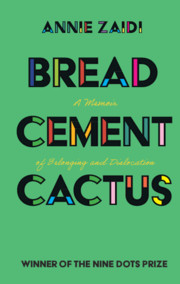
'Bread, Cement, Cactus': some reviews

Bread, Cement, Cactus: A memoir of belonging and dislocation is available in the USA, UK and in India, in print as well as in ebook format. You can buy the book at a bookstore or look it up online. 

A free download is also available at the Cambridge University Press (UK) website.


"In the author’s world, there is space to learn from family and strangers, boatmen and historians, poets and gangsters. She paints a vivid picture of the people she encounters in person or hears about from others. If they come from a different set of life circumstances, she uses that moment as an opportunity to reflect on her own position in society based on gender, language, marital status, religion, parentage and property. This inward gaze is missing from a lot of political analysis about the current state of the country, and that is why this book stands out for its sincerity. It is not a rant; it is sensitive and sophisticated."


- The Hindustan Times 


"In the end, the architecture of the book attempts to lead us towards a counter-resolution that will establish home instead in the paradise of personal experience – in “the morning mist” for example – but this is never as convincing as the lasting sense of indignation and injustice that Zaidi evokes. “What belongs to whom?” she asks. “Who pays the costs of what is taken and cannot be returned?” These are questions perhaps more powerful than the answers Zaidi can provide, but it’s through questions such as these that she points towards the deeper mysteries of our human condition."

- The Guardian 


"Zaidi is keen to tell the stories of people who lose power, and then have to give up ground. The migrants who live on the margins; the Adivasis, who “displaced often, end up in cities where they are reduced to penury and homelessness”; and minorities, including Muslims who face bias in everyday life.

So, this safe place called home, does it exist? For her, a home is where she wants to return to, the heart being a compass. Sometimes, she thinks of home as morning mist, wispy and beyond her grasp."

- The Hindu


"Zaidi shines a light on the horror of what an androcentric society is, yet reiterates the concept of dislocation not only to emphasize the pain women go through but the healing and belonging they could find when following their own path."


"The disenfranchisement of women, anti-migrant and anti-Muslim rhetoric, ghastly incidents such as how the body of a Dalit person was airdropped from a bridge to avoid the upper caste section of a crematorium, and the British legacies that still enable the displacement of forest dwellers and exploitation of natural resources, are juxtaposed alongside personal meditations. At one point, the author recalls how an experiment of living on the urban poverty line of Rs47 a day, even as a person without dependents, made her quickly realise: ‘…all the things that lend me a feeling of home—language, history, memory—would dissolve into the overwhelming consideration of hunger. Food would be home.’

In prose that is admirably both poetic and compact, Zaidi creates in Bread, Cement, Cactus both a memoir of her own multiple belongings as well as a tract that sets out India’s various modalities of displacement. ‘Dislocation can be abrupt but the internal compass dissolves slowly,’ she writes. This book ponders not only that slow dissolution, but a subsequent reassembling too—but always, with the sober acknowledgment of fragmentations yet to come."


Sunday, January 31, 2021

A short story about disrupted conversations online

Here's a short story I wrote about a year ago. It was inspired by Twitter fights. It was published in the Griffith Review's special edition 'The New Disruptors'.


Shalin
Shah is no Muslim name. It comes from Sah. Mis-pronounced as Sha. Stop false propaganda @I.namdaar @Prof_Saab

Namdaar Joker
Shah was a title. Used in Iran. @Prof_Saab Correct me if I’m wrong, but   Gurkha regiment was earlier called Nasiri Gurkha regiment. Why?

Gunjan
In Kathmandu, Kashmiri Muslims were early settlers. 1400s. Some Kashmiris use Shah surname @I.namdaar @Prof_Saab @Shalin

Prof Saab
True. Gorkha regiment was initially called Nasiri. It means friendly in the local language @I.namdaar @Shalin

Namdaar Joker
And what’s your source for info? A five-second dip into the holy waters of Google? @Prof_Saab @Shalin

Read the whole story here: https://test.griffithreview.com/articles/cows-come-home-zaidi/


Sunday, January 24, 2021

On Ghulam Yazdani and preserving that which was

Dr Ghulam Yazdani was the first to photograph Ajanta paintings, and to initiate the first serious conservation of Ajanta and Ellora. His work on the two sites was exhaustive and published in two volumes. He did much more, studying and helping conserve several Indian historical sites, including those in Warangal, Mandu and Bidar. His efforts and scholarship were enabled by the Nizam of Hyderabad. Please read this article for more information on his work. 

Here’s a smaller personal anecdote. In the summer of 2016, I was sent on assignment on the Deccan Odyssey. I wrote the magazine article without mentioning sadness and moments of unease, given the light sprinkling of Islamophobia encountered at various spots.

The trains stopped and allowed us to visit two wildlife reserves, Tadoba and Pench, and sites of artistic and historic significance in the Deccan such as Ajanta and Ellora. The architecture and art is exceptional. That is why people of all faiths come to visit, to admire and perhaps gain some knowledge. In most conversations, local guides tended to emphasize the role of the British in conserving Ajanta and Ellora, when actually this was territory controlled by the Nizam of the kingdom of Hyderabad and it was his administration that conserved and documented much of whatever still remains.  

Some of the guides also attempt to twist the history of Daulatabad. I was traveling with a book (Aurangabad with Daulatabad, Khuldabad and Ahmadnagar by Pushkar Sohoni, published by Jaico) and was able to note these discrepancies. Some people were mouthing the usual falsehoods, describing all medieval-era mosques as having been built on top of temples. The fact of architectural synthesis was twisted further in service of the narrative that Muslim rulers were antagonistic, when in fact, they were creative and very open to local cultural influences. 

I first heard of Dr Yazdani at Ellora. I had walked away from my own group and guide, and was walking past another group when their guide mentioned the Nizam’s role in the conservation of the temples. I stopped to listen and as the group began to walk further, I sidled up to their guide and asked: what were you saying about conservation? 

He told me about Ghulam Yazdani's enormous work and the state of Hyderabad preservation of Buddhist, Jain and Hindu sites. I expressed surprise because our guide had not mentioned this at all. The young man just smiled.

We had our respective jobs to do, so I thanked the younger guide and perfunctorily exchanged names. His was a Muslim name too. As he left, there was that smile again, rueful. I understood this time what it suggested: it is not so much that accredited guides don't know but that they want to forget, to discredit and to disengage from a better past. The positive role played by Indian Muslim scholars mattered to him. And it mattered to me. It mattered very little to most others. 

I have forgotten that guide’s name now, but I have not forgotten that look of pained understanding in his eyes, that rueful smile. And perhaps he read some recognition in the rueful smile I returned before turning away. 


Tuesday, December 29, 2020

Some thoughts on sanity, truth, violence and protest

I was interviewed recently by Saumya Kalia for Outlook magazine. One of the questions she put to me was taking off on something I said after my book Prelude to a Riot won the Tata Litlive Award for fiction. 

I directed my comments towards the sponsors of literature festivals and book prizes, and the question and answer that follow build upon some of my thoughts: 


"On winning the Tata Live book prize, you wrote about sponsored literary festivals and the motivation of the rich and powerful to get speakers to participate. For any society to remain sane, a little truth must survive, was your hypothesis. Can you explain what you mean by that?"

Me:  The question of who sponsors art, and what art achieves in any society, has been troubling me for a long time. The vision of artists and their sponsors is often at variance. How does this relationship work, then? Artists are dependent on others, not just for their income, but also for spaces (physical, digital, metaphorical) wherein they engage with their audience. Picasso can make Guernica, but where will it hang? Will it survive if the powerful decide to get rid of it? Some of the greatest Renaissance art in Italy was commissioned by patrons like the Medici family, bankers and businessmen. Why did they bother? We have had stories told down the ages about kings and queens, their infidelities, filicides and parricides. Books, plays, oral storytelling arts were supported by the nobility or very wealthy merchants for most of our history. Why did they not insist on censoring all stories so that the nobility was only cast in benevolent light?

This might be for multiple reasons. One, truth itself is powerful. Those who wish to remain powerful must retain an acquaintance with the truth. They may serve disinformation to the rest of the country, but they themselves must have access to correct information. They may not invest in mass access to the arts, but they themselves must have access to the vision, the beauty and even terrifying clarity that artists bring. Two, lack of truth is associated with breakdowns of all kinds. What do we recognize as a loss of sanity? It is a state in which you can no longer tell what is real and what isn’t, what is harmless and what isn’t. Individuals who lose touch with the truth react in unpredictable ways. A society cut off from the truth, and from truthful art, starts to lose itself in similar ways. It becomes unpredictable and does not necessarily act in self-interest, much less underwrites someone else’s profit. Alternately, the truth goes underground, leaving the powerful in the dark and, this is worse for them. Look at any society where truth and art have been suppressed, and you will see that it is a sick/sickening society or a nation at war. I don’t think this state of affairs suits too many people, not for too long anyway.

The full interview is available here: 

https://www.outlookindia.com/website/story/annie-zaidi-on-culture-of-protest-identity-and-expression/368316


Monday, December 28, 2020

On touching, un-touching and segregation

From my essay on learning from the lockdown and the new normal, published in The Indian Express:

In the new millennium, I saw new kinds of informal touch: air-kissing, fist-bumps, high-fives. By early 2020, the casual half-hug had little emotional significance. It remained, however, a significant social contract. Hugs assured participants of a certain peerdom for, always, there were others, people bricked off from your affection. You could always tell which social class you belonged to based on who gave you a hug while leaving the room, who would merely nod, and who didn’t feel the need to acknowledge you at all.

Now that separateness is the norm, now that we hesitate at thresholds and elevators and are constantly alert to each body’s proximity, I see clearly what was always there, but not easy to acknowledge. Casual social hugging had become one of those tools that affirmed class distinctions.

Indians are not new to social and physical distancing. Long before the pandemic, there were separate lifts and staircases for ‘service’ staff. Private gardens restricted access to “non-residents”. It is no secret that most upper caste households keep separate cups and plates for domestic workers. There are apartment complexes where Muslims or Dalits may not reside even if they can afford to. Public parks charge entrance fees, effectively barring the poor and the homeless. Kids are routinely segregated via food with certain schools insisting on vegetarian tiffin, and many states refusing to allow eggs or meat in school lunches.

Read the whole essay here: https://indianexpress.com/article/express-sunday-eye/social-distancing-is-now-the-norm-but-segregation-has-always-been-around-7121312/

Saturday, December 19, 2020

On English, elitism and writing in India

A short passage from an essay I wrote about Indian writing in English, and the insinuation that it was an elitist club:

Occasionally, I also heard charges of elitism levelled at this club and, in the beginning, these made me nervous. I knew Hindi well enough but English was the language I could touch with no gloves on. I was aware that it was accessible to a smaller fraction of the population but if we were going to do fractions, what language didn’t have its elites, its tell-tale dialects that gave away the country cousin, the migrant, the unlettered worker? Even so, a tail of suspicion attached itself to cultural production in English. The baggage associated with its colonial antecedents has shifted so that, instead of examining the inheritors of actual power – politicians, priests and businesspeople – a certain outsider-hood was invented for those who had a special relationship with English.

These suspicions confused me. Growing up, much of my reading was English ‘classics’, which is to say, mainly British novels and plays, some American short stories and translated works from Russian, German or French. Later, travelling and working as a journalist, I saw that the concerns of people remain the same, no matter what language they spoke: how to survive, how to secure your present so the future appears a little less uncertain, how to gain freedom, how to protect a reputation, how to find and keep love, how to transgress without being destroyed by the hegemony of the day. Such were the struggles and conflicts described in the stories I read, whether they were set in nineteenth century pastoral England or twenty-first century India. Was it possible to measure the democratic quotient of a book based on how many people could potentially read it? And what happens to nations where the majority is unlettered? Are all literatures elitist if most people cannot afford to read for pleasure?

Full article in Outlook; link here: https://magazine.outlookindia.com/story/books-way-through-an-old-sieve/304029 

Saturday, October 10, 2020

A new review for Unbound

We do the work of creation in the hope that it achieves something in our communities. Something gentle, or fierce, or resplendent. Something that makes the world tilt, even if it is just at the molecular level. 

Today, I was feeling rather gratified at finding a review of Unbound: 2,000 Years of Indian Women's Writing. The book was published about five years ago and I wasn't expecting anyone to review it now. However, a reader has offered a very kind and personal response to the book. 

Aparna Ravikumar says: "This anthology’s charm lies in the way it has been put together. I could easily slip into the pages with an “Aha” moment here and an epiphany there. And slip out just as easily to have a meaningful discussion with the other mothers while waiting for our daughters at dance rehearsals. In the waiting room during my Dad’s surgery while reading the excerpt from Bama’s Chilli Powder with my mother, the lady next to her managed a chuckle through her snot-crusted, teary face. That’s when my mother realised that she was reading it aloud."

This is what one hopes to achieve when one puts together an anthology like Unbound: to convey to the reader the harsh beauty, the comedy and the farce, the sadness of this world, to deliver into their hands the words that have help us survive. Our foremothers, us, hopefully future generations too. Editing this anthology was hard work but I found my own cultural history and spiritual strength through all the reading I did while researching it. Seeing this review reminds me, once again, that those three and a half years was time well spent. 

Friday, July 03, 2020

In spitting distance of flammable

The meaning of spit changes with context. Literature is full of spitters and the spat upon, from Shakespeare’s Merchant of Venice to Khushwant Singh’s Train to Pakistan to Raj Rao’s Kanthapura. In all of the above texts, a powerful person or dominant community spits or threatens to spit upon the vulnerable, as a way of demonstrating that they can. I was also reminded of Ha Jin’s War Trash, set in the Korean War of the early 1950s. Towards the end, Chinese prisoners of war are given a choice between repatriation to the Communist controlled mainland and going to Taiwan. China was persuading them to return to the mainland. One member of the group that did not want to return suggested spitting at “the Reds” as a way of pre-empting any veiled threats and making their opposition public.

The gesture is always underpinned by anger. In Hindi, we have a saying, ‘gussa thook do’ (spit out your anger) which is a request to calm down or let bygones be. There are other proverbs such as ‘thook ke chaatna’ (licking your own spit), equivalent to eating your words, and ‘aasmaan pe thookna’ (spitting at the sky), which indicates your insignificance relative to the object of your criticism. A person may also be described as ‘thookne laayaq’ (worth spitting at) or not worth even that. Some people spit or say ‘thoo-thoo’ aloud as a superstitious gesture, intending to ward off evil. However, saying the word ‘thoo’ universally signifies disgust, and was recently deployed on Twitter as a hashtag[ii] aimed at journalists[iii] who were accused of fanning Islamophobia during the pandemic.

Read the full post at the CUP blog: 

New notes on Facebook

Yes, yes, Facebook. Carry on spying. I visited Lithub. Show me all the Lithub you've got now. The worst material there might be on Lithub, you've presented to me. Does it not strike you that I am already acquainted with Lithub, outside of you? That I visit other literary sites without any prodding from you, and therefore you bring me nothing I don't already have? What's the point of this? Think, Facebook. Think a little harder about what you want from me.


Update: I thought Facebook and I were starting to level with each other. It figured out that I do 'buy' stuff online but not via FB, and also that I am a mindless consumer of news and trivia items out of a box vaguely labelled 'culture'. Armed with the least and the most valuable items in the information bazaar, it wrestles with my timeline. It *will* have my time and attention if it cannot have my money. Except that we now live in an attention economy (about which you may want to read this wonderful book (free download: https://www.cambridge.org/core/books/stand-out-of-our-light/3F8D7BA2C0FE3A7126A4D9B73A89415D) and therefore attention is money.

However, FB is also chasing me with 'leisure' garments. It really does spy. It knows I finally caved in and made an online purchase of cloth (and yes, I've got the ad settings fixed and yes, I would prefer it if it did not spy). I must confess that Fareeda Gupta has latched onto the right idea - home-ish clothes that can double up as sleepwear, but the top looks enough like a kurta that you might wear to work, and is therefore suitable for online meetings.

There are the 'festival edit' ads too, ahead of Bakreid. One gharara suit-set costs as much as two goats, or a goat and two chickens. Not buying. 

It does persevere with sarees too. It knows that anyone who wears them, wants them. But it doesn't yet know that I am put off by anything that advertises itself as being favoured by 'independent' women. I am only mildly amused at branding that suggests that independent minds prefer to be led by the auto-suggestion of independence via nice fabric and photography. Anyway, to save Facebook the trouble, I thought I'd help it make some ad choices for me. Try showing me a brand that isn't trying very hard. 

P.S: about those 'luxe' ads, I can't make out whether they're for the dishes or the food arranged on the dishes. Not buying. Just saying.


Thursday, May 28, 2020

Saturday, May 02, 2020

Because grief is not an event you can cancel


Behind all funerary efforts and expenses is the urgent need to confront the loss of someone with whom you had (and continue to have) a unique relationship. You acknowledge the person not just as blood and flesh but as someone who was at the centre of a distinct web of relationships, with a distinct place in this world. The food, the sharing of memories, the travel helped the bereaved move past the fact of a death and into the continuum of life.

During a pandemic, however, the last rites do not permit gathering and rallying around. Old friends won’t be sending floral tributes, or condolence cards. There will be no hugs. Grief will hover in the air. Like the virus itself, it might cling to your breath, hair, clothes, the undersides of your shoes.

Yet, grief is not an event. It can’t be cancelled, or even postponed. It has to be worked through, performed, acknowledged.

Please read this brief essay about coping and adapting to make room for grief (or joy) during the lockdown:

Friday, April 24, 2020

A new short story

Here's a new short story, recently published in The Charles River Journal.

The story is called 'Jhimmi'. It was written after I began reading reports about young lovers in India, barely out of college, and the outcome of their loves. I was struck by the strength of their love, their courage, their big hearts. Above all, that: their sheer heart. Their circumstances or fates are secondary after all.

Remember how I was giggling? Giggled non-stop until people turned around to stare. You kept asking, what’s so funny? It was the guide, going on about the emperor having hundreds of wives and concubines. In my head, I was seeing the Red Fort filled with crawling babies. A hundred white diapers. Little red brocade caps for the boys. In my head, a hundred babies were in the Diwan-e-khaas, on hands and knees. Hanging onto the knees of their father, the Emperor.

Can you see it, Bitoo? Badshah Salaamat has three babies perched on his lap. One of them has a leaky diaper, so His Highness gets miffed and he calls out to someone to take this prince away and change his diaper. What’s Urdu for a soggy diaper? The throne will need to be washed. And all those courtiers, their spines erect. Fancy turbans. Keeping a straight face. Bowing to the babies who tug at their belts. I was imagining the Prime Minister, holding out one heavy beringed finger, and the crown prince trying to chew on it with toothless gums.

Why didn’t I tell you right then, when you asked what’s funny? I thought I’d tell you later, at night, when we would be alone in our hotel room. But there was no room...


Read the full story here: Jhimmi - a short story by Annie Zaidi

Saturday, April 18, 2020

No capes

One thing is clear. No heroes wear capes. They wear makeshift masks, often just a kerchief folded over and tied around their noses. Slender protection against the virus that can kill with so much as the touch of a doorknob, or passing through a room in which someone else has coughed. And they take their chances with death, because they must feed their families, but when they discover that the neighbours need vegetables, they bring some for them too. Adding at least four kilos to their already heavy burdens. Men who don't have big cars. Men who don't own the apartment. Men who need not do this, for it wasn't expected of them. To agree to spend an extra few minutes at the grocer's, to spare another family an outing that would expose them to greater risks - it may not be the same as going to war, but when life and health is at stake, it counts as heroism. Above all, it counts. 

Thinking of a madarsa during the lockdown

I walked away that afternoon with a heavy heart. When I looked around the building, I saw an open terrace where laundry was drying, and large rooms shared by several girls. This was not very different from the hostel I lived in as an undergraduate. It was just much poorer.

In college, I lived in a hostel administered by nuns. It was very strict. We were not allowed to step out without written permission nor receive visitors other than families. Meal timings were strict, as were bath times. The very taps were locked up and warm water rationed in winter. We were well fed, of course. Each of us had a bed to herself but we certainly didn’t have six feet of space between beds.

The madrasa was one tenth the size of the hostel I lived in, perhaps smaller. It didn’t have a vast campus attached or the real estate to allow sports. It certainly didn’t have the money for lessons in art. It probably didn’t serve pastries on Sunday afternoons.

I think of those little girls now, during this harsh lockdown. If, instead of four hours, the Prime Minister had given them four days’ notice, they still wouldn’t have been able to go home.

Read the full article here:

https://www.thehindu.com/society/how-can-a-poor-madrasa-magically-conjure-up-many-more-rooms-in-the-midst-of-a-lockdown/article31366116.ece

Thursday, April 09, 2020

A lockdown letter from where I am


My eyes barely left my phone screen. It was like being in a tunnel where the roof has fallen in, our collective hands bloodied from trying to dig out despite a lack of tools. All tunnels have ends, of course. Perhaps it will be three months, not three weeks. Or three years. Everyone says to brace yourself. On the other end of the tunnel could be a mess of an economy and millions of starving people with low immunity. And who knows what the spring harvest was like? How much were farmers able to store? Was the government able to procure enough grain?

It became impossible to read or write about anything outside of this. My mind turned circles around words like decency. Dignity. Equality. It returned to warm spots of memory—places blue and burnt sienna, sprawling libraries. It also sprang towards terrifying stories of famine from the last century.

For some reason, I also kept returning to the image of a maze: the Bhoolbhulaiya in Lucknow’s Bada Imambara. It is full of sunlight glancing off honey-tinted stone walls. People must have had a taste for perplexity back in the day. Perplexity can be charming, unlike the grim certitudes of a tunnel. Not everyone makes it out though. I caught myself thinking of a chakravyuh—a military formation whereby you are encircled and trapped. With surveillance and restricted mobility becoming acceptable in the name of public health, was this the beginning of something more dangerous, more discriminatory than a virus?

Read the full text here: 
https://www.zocalopublicsquare.org/2020/04/08/letter-from-mumbai-covid-19-coronavirus/ideas/essay/

Friday, April 03, 2020

Re-use, reduce, recycle

There's been this saree tag doing the rounds on Facebook. I was tagged too. I am not in a mood to post happy pictures. However, since many people here have spare time for reflection or experimentation or learning new skills, I'd like to tweak the tag and focus on how to shift our culture away from relentless consumption, especially of cheap garments. Excessive mass production of clothes means under-paid workers and a very polluted planet.

A lot of our habits of consumption come from our inability to refurbish and repair cloth. You can put it down to lack of time, but the honest truth is the most young people nowadays don't have the skills. There is zero respect for artisans' skills (because we consistently under-pay them and get away with it), and so middle class kids are not taught to sew, mend, dye, embroider, starch. We certainly do not know how to make paint or dyes. I was lucky to be taught the basics of sewing as a schoolgirl, and because I was interested, I also began to experiment a little with the sewing machine a few years ago. However, I didn't know much repair work and I didn't know how to dye.

Last year, I decided to teach myself. I upped and went to the market one day and bought some dyes, and a giant pateela (of the type you cook biryani in). I threw in some faded clothes that I would otherwise have given away. Because I had no instruction (except youtube videos) and because I didn't know enough about fabrics (what sort of cotton can take what kind of dye etc), I did make a mess of almost everything I attempted. However, this saree turned out okay enough for me to wear out to an event. (I do wear the ruined clothes too, within the house).

This saree was a cream organdy with applique booti work that had a tinge of maroon. My mother bought it in Lucknow, perhaps in the early '90s when organdy was still popular. She wore it until the hem was discoloured and fraying. The stiffness had also gone out of the fabric. Then, after some intense washing in the machine with multi-coloured clothes, it was marked with pink and blue splotches. So I decided to dye it a dark pink.

What I learnt through doing it is that, dyeing fabric is much harder than it looks. It is physically hard, being near a hot boiling vat for that long. If you use chemical dye, there are fumes (I didn't know better and will try to find organic dyes in future). One also needs a stick or stirrer of some kind and I didn't have one, so I used the broken leg of a chair. The stirring was hard too, and you have to be cautious to dip and move the fabric along carefully so that the colouring is even.

I actually did a shoddy job in that the fabric did not take the colour evenly. But that's not immediately obvious to anyone who isn't looking too closely. I wore it to work (a book event) and hoped nobody was looking too closely. If they were... well, you would have thought that I was wearing a faded old saree and that would be an absolutely correct deduction, of which I am not ashamed.

The blouse is old too, also belonged to my mother. It is also at least 20 years old and the fabric is fine.

I don't know if I'll wear this saree often, because I don't wear any sarees too often, but these five yards have served us very well. Perhaps I'll cut it up and turn it into something else later. A scarf, a dress, a curtain, a shirt, a dishrag?


In turn I've tagged friends who have successfully turned sarees into something else, or refreshed fabric instead of throwing it away and buying new stuff. Consider yourself tagged if you feel like it. And reduce, re-use, re-cycle.

Photo courtesy the TATA Litlive festival. I'm afraid I don't know the photographer's name. Happy to credit if you raise your hand.

P.S.: If you're wondering at my expression, this is me looking at Shanta Gokhale and wondering when I would grow up to be as lovely, as spirited and as smart as she is.


Thursday, April 02, 2020

When hunger is the tragedy...

My mother attempted to buy vegetables last week, right outside the gates of the housing complex, and she witnessed police officials preventing sales. A cart or basket had been overturned. Vegetables lay crushed in the dirt. She saw desperate folk picking up the damaged food when they thought the cops were not looking. Her recounting of this brief experience triggered something within me. That, and reports of migrant workers – suddenly out of work, hungry, and trying to walk hundreds of kilometres on foot.

I began to think of ‘The Song of Famine’, a long chapter embedded within a travelogue written by the French traveller Pierre Loti. India was published in 1901, just after a major famine had affected many parts of the country, Rajasthan in particular.

In the city of Jaipur, Loti documented what he saw:

“Servants lead tamed cheetahs belonging to the King through the streets. These are led on slips so that they may become accustomed to crowds, wear little embroidered caps tied under their chins with a bow…But there are also many hideous vagrants— graveyard spectres like those lying at the rampart gates. For these have actually dared to enter the rose-coloured city and to drag their skeletons through the streets. There are more of them than I should have thought possible…horrible heaps of rags and bones lying on the pavements hidden amongst the gay booths of the merchants, and people have to step aside so as not to tread upon them. These phantoms are peasants who used to live in the surrounding districts. They have struggled against the droughts which have brought destruction to the land, and their long agony is imprinted on their incredibly emaciated bodies. Now all is over; their cattle have died because there was no more grass, and their hides have been sold for a mere trifle. The fields which they have sown are only steppes of dusty earth where nothing can grow, and they have even sold their rags and the silver rings that they used to wear on their arms and ankles so that they might buy food…They thought that people would take pity on them, and would not let them die, and they had heard that food and grain were stored here, as if to resist a siege; they had heard, too, that every one in the city had something to eat. Even now carts and strings of camels are constantly bringing sacks or rice and barley that the King has procured from distant lands, and people are piling them up in the barns, or even on the pavements, in dread of the famine which threatens the beautiful city on every side. But though there is food it cannot be had without money…”


I began to read this chapter again once pictures and videos began to emerge of migrant workers and their families trying to leave cities after A sudden lockdown was announced to combat the ongoing Corona virus pandemic. People are heading back to villages where they hope to be fed. Perhaps they could live off the fruits of the land, if they have any, for a while. Perhaps they could shelter in a hut that’s not in an overcrowded slum. At the very least, if they die, their families will know what happened.

Read the full article here:
Tweets by @anniezaidi